
Multinational Team Charts a “Field to Factory” Blueprint for Transforming Crop Breeding
Source:华大万物 View count:78977
Recently, investigators from multiple institutes including the Chinese Academy of Agricultural Sciences (CAAS), BGI Bioverse, Peking University Institute of Advanced Agricultural Sciences, and Wageningen University & Research in the Netherlands outline in Molecular Plant a strategic framework for the plant breeding factory (PBF), a proposed controlled-environment system designed to move most pre-field-trial breeding steps indoors and shorten the lengthy timeline of crop development.
An opinion titled “Revolution in Plant Breeding: From Field to Factory” published in Molecular Plant.
Plant breeding typically requires 5 to 25 years to complete a breeding cycle. For major staples such as wheat and potato, the pace of genetic improvement is falling short of what a growing global population needs under increasingly volatile climate conditions. Extreme heat, drought, and shifting pest pressures further erode crop productivity, yet conventional field-based breeding, which depends on seasonal cycles and multi-location trials, struggles to keep pace.
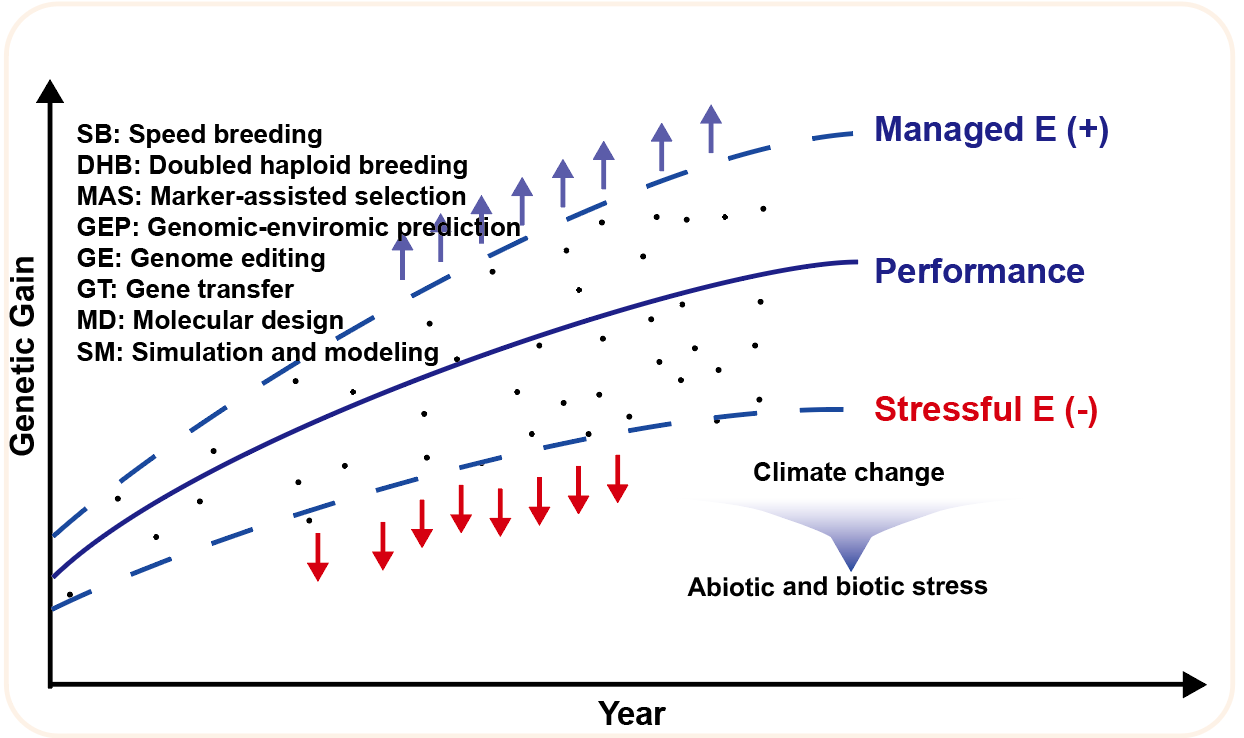
Genetic gains from breeding technologies are increasingly offset by climate-driven stresses, underscoring the urgency of accelerating crop improvement to sustain global food security.
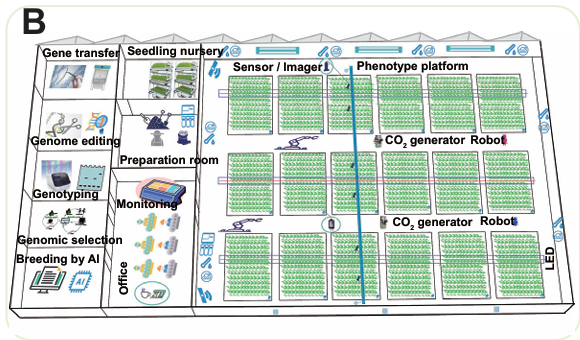
The plant breeding factory integrates molecular selection, controlled growth, and high-throughput phenotyping into a single indoor workflow, streamlining steps that traditionally span multiple field seasons.
The proposed PBF brings together established and emerging breeding technologies into a single, coordinated indoor workflow built on three core functions. The first, molecular selection, draws on marker-assisted selection, genomic selection, and genomic-enviromic selection to identify desirable genetic profiles. The second, accelerated growth cycles, manipulates light, temperature, CO2, and nutrients to shorten a plant’s life cycle well beyond seasonal limits. The third, prescriptive molecular design, uses environmental and genomic data to tailor crop lines for specific target regions.
The authors envision a five-generation development roadmap, from PBF 1.0, which focuses on inducing early flowering, through PBF 4.0, which integrates artificial intelligence and design breeding. PBF 5.0 remains the authors’ speculative, longer-term vision of biosynthetic breeding and production. For responsive genotypes of some field crops, validated speed-breeding protocols can already produce four to six generations per year, compared with roughly two under conventional conditions.
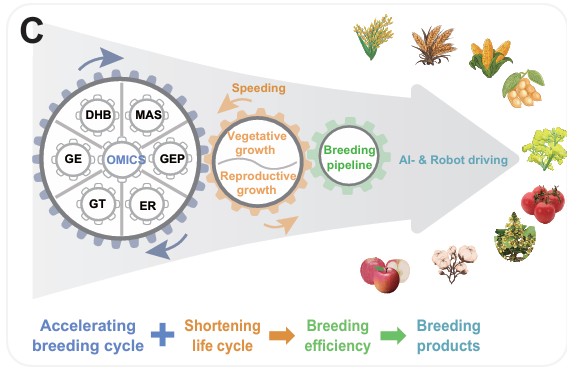
Central to the framework is enviromics, the systematic measurement and use of environmental data in breeding. Where genomics reads a plant’s DNA, enviromics reads the conditions that shape how those genes perform: temperature, light spectrum, moisture, soil nutrients, and their interactions. By profiling the environmental “fingerprint” of a target farming region and reproducing key stresses such as heat or drought inside the factory, breeders could identify which genetic combinations confer resilience before committing to costly field trials. The integration of enviromics with genomic prediction, termed genomic-enviromic selection (GES), may improve the ability to forecast how indoor-selected lines will perform outdoors. The authors acknowledge, however, that controlled facilities cannot fully replicate the complex fluctuations of natural field environments.
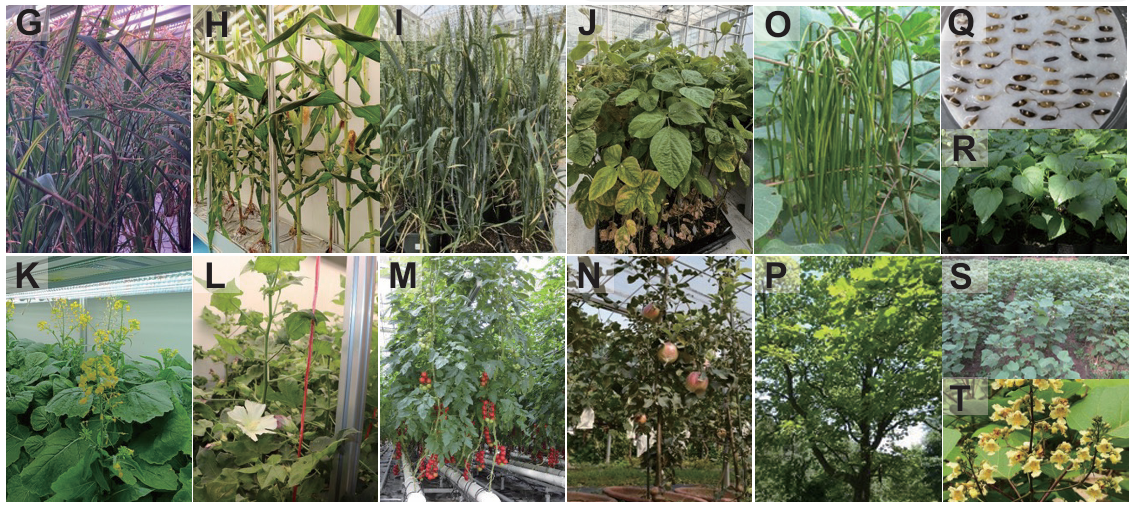
The article distinguishes three application scenarios. Indoor crops such as leafy vegetables, already largely bred in controlled settings, stand to benefit most immediately. Field crops such as cereals could complete early-stage generation advancement and stress screening indoors, with promising candidates then advanced to limited, targeted field evaluation. Perennial species such as apple trees could undergo controlled early-flowering induction to shorten the juvenile period, with seedlings then returned to outdoor conditions. The authors provide illustrative cost projections of approximately US$500,000 to US$850,000 per year for a breeding facility, noting that these are order-of-magnitude estimates requiring refinement through pilot operations. Although per-season factory costs are typically higher than field breeding, the time gained through faster generation turnover could, in commercial programs, improve return on investment through earlier product release and faster recycling of successful parental lines.
The article distinguishes three application scenarios. Indoor crops such as leafy vegetables, already largely bred in controlled settings, stand to benefit most immediately. Field crops such as cereals could complete early-stage generation advancement and stress screening indoors, with promising candidates then advanced to limited, targeted field evaluation. Perennial species such as apple trees could undergo controlled early-flowering induction to shorten the juvenile period, with seedlings then returned to outdoor conditions. The authors provide illustrative cost projections of approximately US$500,000 to US$850,000 per year for a breeding facility, noting that these are order-of-magnitude estimates requiring refinement through pilot operations. Although per-season factory costs are typically higher than field breeding, the time gained through faster generation turnover could, in commercial programs, improve return on investment through earlier product release and faster recycling of successful parental lines.
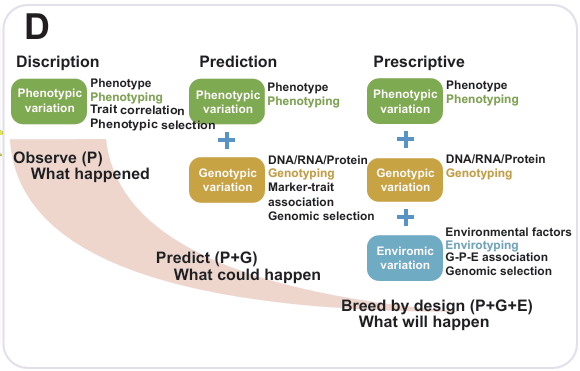
Breeding selection has advanced from field-based phenotypic observation toward genomic-enviromic prediction, where environmental data and molecular design converge for target-environment breeding.
The authors stress that some crop species, the PBF is proposed as a complement to conventional field breeding, not a replacement, and they advocate staged, crop-specific pilot deployment. Field evaluation, they note, may remain indispensable for some species with complex genotype-by-environment interactions.
As climate pressures intensify and breeding data, AI capabilities, and environmental-control technologies continue to advance, the convergence of these tools within factory-based platforms could offer a new path toward developing resilient crop varieties and bringing them to farmers’ fields sooner.
This article is available at: https://doi.org/10.1016/j.molp.2026.07.017