
Plant Once, Harvest for Years! Why Is This “Long-Lived Yucao” So Powerful?
Source:华大万物 View count:433534
Plant once and harvest for years, with fresh grass yield of 8–10 tonnes per mu and crude protein above 10%. This is not a vision of future agriculture but the “perennial maize forage” that has already been promoted in more than 10 provinces across China, with cumulative planting of over 50,000 mu.
Recently, the research team led by Professor Tang Qinlin of Sichuan Agricultural University, in collaboration with a BGI research team, published a paper in the plant science journal The Plant Journal, decoding the two genetic forces behind the grass’s vigorous growth: heterosis and genome dosage effects.
Three species “team up” to create a new grass
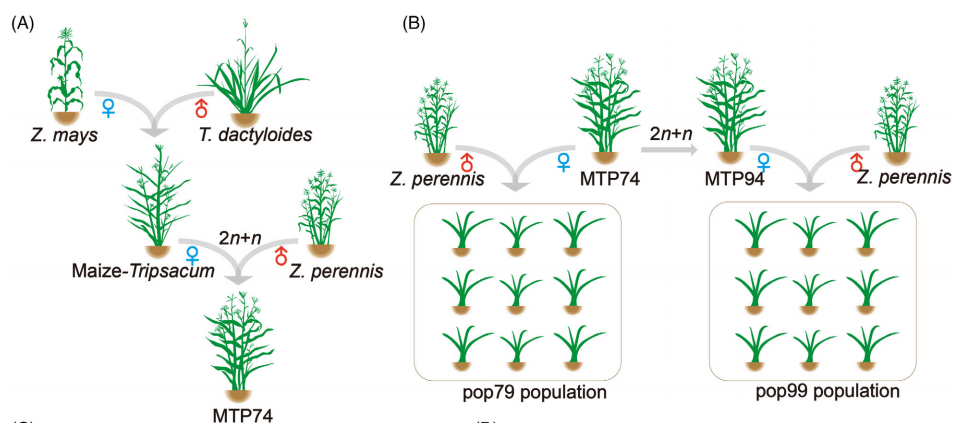
Perennial maize forage is developed by crossing three plants: maize, tetraploid gamagrass (Tripsacum dactyloides), and tetraploid perennial teosinte (Zea perennis). Maize contributes high-yield genes; teosinte brings the perennial “long-distance” constitution; gamagrass adds stress resistance and tillering.
To combine three genomes, the team designed a route of “stepwise hybridization + 2n+n sexual polyploidization”:
Tetraploid maize × gamagrass produces hybrid F1, which is then crossed with teosinte. Through the “2n+n” mechanism, chromosomes from the three species are brought together into the same plant, and backcrossing can further accumulate the teosinte genome.
In the two large segregating populations constructed, 72.3% and 66.7% of individuals, respectively, had fresh weight per plant exceeding that of the best parent—abundant superior combinations are hidden in the populations, waiting for breeders to select.
Heterosis: saved energy goes into growth
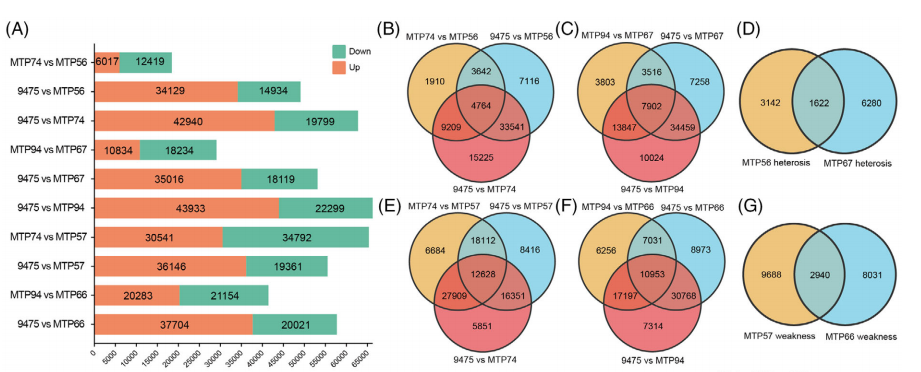
Why do some progeny grow exceptionally vigorously? Transcriptome analysis provides an “economical” answer.
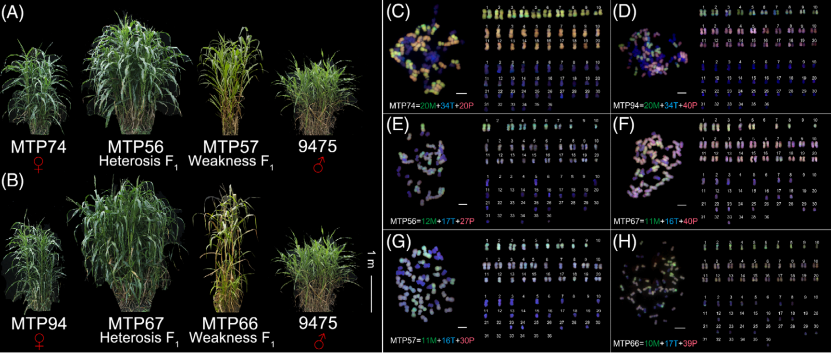
Comparing heterotic and weak combinations, the researchers found that superior lines down-regulated a major energy consumer—the protein quality control system—and reallocated the saved energy to sugar metabolism and carbon fixation, converting it into real biomass. Weak lines showed the opposite: nitrogen metabolism and photosynthesis pathways were abnormally activated, energy was wasted, and growth was poor.
This supports the classic “energy use efficiency hypothesis”—the essence of heterosis is knowing how to “live economically.”
Dosage effect: one more genome set, one more increment in yield
Heterosis is responsible for “cutting expenditure,” while the dosage effect is responsible for “increasing income.”
The study found that for each additional set of teosinte genome, plant height increased by 5.90%–17.64%, fresh weight per plant increased by 5.08%–37.99%, stomata became larger, and photosynthetic capacity was enhanced. More interestingly, what determines vigor is not only the number of chromosomes but also “which chromosomes are present”—tiny differences caused by chromosome “shuffling” can lead to huge phenotypic differences. This provides a basis for future “chromosome shuffling-based karyotype design breeding.”
In one sentence: hybridization improves efficiency by “cutting expenditure,” while dosage makes increments by “increasing income.” The two paths work together to create the vegetative vigor of perennial Yucao.
From paper to field: Yucao series already on duty
Mechanisms in the laboratory must ultimately be tested in the field.
Using perennial vegetative propagation, the team “locked in” heterosis and dosage advantages and bred nationally approved forage varieties such as Yucao No. 5, Yucao No. 6, and Yucao 9919, achieving stable propagation of the varieties.

Field data are impressive: Yucao No. 6 has an annual fresh grass yield of 127.7 tonnes/ha, and Yucao 9919 reaches 142.6 tonnes/ha, 156%–186% higher than the control silage maize; whole-plant crude protein content exceeds 10%, with high yield and good palatability.
Three species “team up” to fill marginal land
Southern and southwestern China has large areas of sloping farmland, abandoned land, and rocky desertification land—growing grain is laborious and unprofitable, while leaving it abandoned is a waste.
Perennial maize forage fits well: it tolerates sloping land and hills, is planted once and harvested for years, upgrading “plant one year, harvest one crop” to “plant once, harvest for years.”
Demonstration Planting Base in Chuxiong Prefecture, Yunnan Province

Its core selling points can be summarized in three words: high tillering—more than 80 tillers per plant, growing more vigorously after each cut; long-lived—stand life over 5 years, continuous returns from one planting; fast-growing—fresh grass yield of 8–10 tonnes/mu/year.
Adoption results in multiple locations best illustrate the point:
Sichuan Province
Since 2019, Ningnan County has introduced the Yucao series, and county-wide promoted area has exceeded 2,000 mu.
The forage can be cut 2–3 times a year, with a yield of 8–10 tonnes/mu; the cost of green and roughage has dropped significantly.
Biogas slurry is returned to fields to improve soil fertility and reduce chemical fertilizer input; the “livestock–biogas–crop” circular model has been rolled out across the county.

Guizhou Province
In 2025, under the guidance of the Guizhou Provincial Grassland Technology Test and Extension Station, Yucao was demonstrated in 31 counties across 9 prefectures/cities in the province.
Perennial Yucao overwinters reliably and can be cut continuously; the first cut in the following year yields 3.5–4.7 tonnes/mu, with crude protein reaching 14.44%.
Planted on sloping farmland and hilly land, it does not compete with staple crops for land, and each mu can absorb 6–8 tonnes of livestock wastewater per season, filling the gap in quality forage for mountain herbivorous livestock.

Hunan Province
From a 10-mu trial in Taichang Township, Yuanling, in 2024, to nearly 100 mu in 2025, and to 500 mu of pilot-scale extension in 2026—a “small trial → 100-mu scale → large-scale extension” three-step leap.
With its palatability and yield potential, Yucao has won tangible recognition from local farmers.

For growers, perennial maize forage means lower labor and input costs; for the livestock industry, it means stable, high-yielding, quality green feed; for the hilly and mountainous areas of southern China, it is a sustainable path of “integrating crop and livestock production, achieving both ecological and economic benefits.”
From the aggregation of three species’ genomes to the locking-in of advantages and field deployment, the story of this grass has just begun.