
People’s Daily Overseas Edition | “Perennial Rice Brings Us Bountiful Harvests and Deepens Friendship”
Source:People’s Daily Overseas Edition View count:63224
Editor’s Note
On the occasion of the Forum on China–Africa Cooperation, People’s Daily Overseas Edition tells the story—through the perspectives of local African agricultural experts and partners—of how BGI has actively promoted perennial rice in Burundi and Uganda, providing innovative solutions to local food security challenges.
The following content is sourced from People’s Daily Overseas Edition.
Perennial rice is a type of rice that can be harvested multiple times after a single planting. It avoids the labor-intensive processes required by traditional rice cultivation, such as plowing and re-sowing each season, greatly reducing farmers’ labor costs and production expenses. In recent years, as China’s perennial rice technology has taken root in Africa, local rice yields have increased, and China–Africa friendship has continued to deepen through agricultural cooperation.
| “Bringing New Opportunities for Agricultural Development in Burundi and Across Africa”
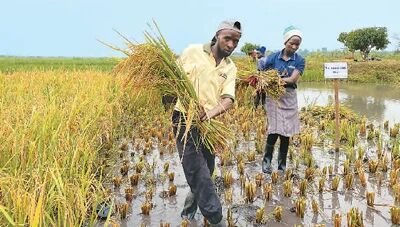
In Burundi, located in east-central Africa just south of the equator, lush green rice fields are neatly divided by ridges. Staff along the ridges carefully record the growth conditions of the rice, while Chinese researchers and Burundian agricultural experts jointly monitor the development of the rice in this experimental field.
Burundi has a subtropical and tropical climate with abundant light and heat resources. Ample sunshine nurtures local crops such as maize, beans, and bananas. However, limited agricultural technology has long constrained the country’s food security. Agricultural cooperation between China and Burundi has a long history. Since 2009, China has dispatched multiple agricultural expert teams to assist Burundi. Chinese crop varieties and agricultural science and technology have crossed mountains and seas, taking root on the African continent thousands of miles away.
In July 2023, Burundi’s First Lady Angeline Ndayishimiye visited China and toured the BGI Bioverse Dapeng Agricultural Science and Technology Demonstration Base. Walking into the perennial rice demonstration field, Chinese researchers placed a rice seedling in her hand and explained in detail the breeding process and the “one planting, multiple harvests” characteristics of perennial rice. On the spot, she proposed establishing a perennial rice planting demonstration base in Burundi.
The two sides quickly reached an agreement. After joint efforts and careful preparation, in January 2024 Chinese agricultural experts stationed in Burundi successfully cultivated the first batch of perennial rice seedlings locally. Both sides were greatly encouraged, and Chinese experts carefully passed on their experience in transplanting perennial rice to local cultivation and management personnel.
In April 2024, Ndayishimiye, together with Prudente Ntar Mahoromeza, the national project director of Burundi, visited the perennial rice demonstration base to gain an in-depth understanding of its cultivation. What greeted them were stretches of dense, verdant rice fields. Walking slowly along the ridges, Ndayishimiye frequently stopped to talk with BGI agricultural experts, asking about planting techniques, yields, and market prospects. She said, “Seeing perennial rice successfully promoted in Burundi makes me very happy and reassured. This is not only a model of agricultural cooperation between Burundi and China, but also brings new opportunities for agricultural development in Burundi and across Africa.”
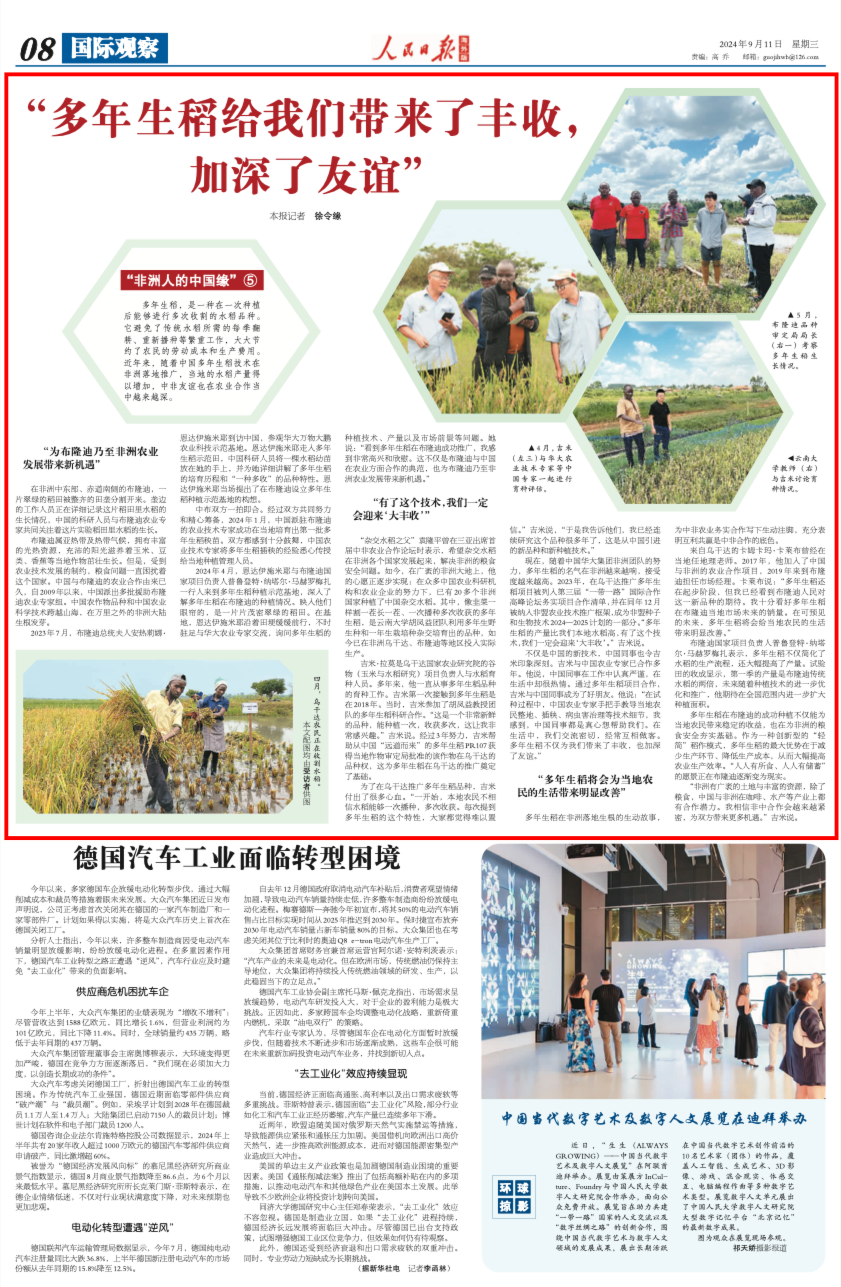
In April, Ugandan farmers harvesting rice
| “With This Technology, We Will Surely See a ‘Bumper Harvest’”
Yuan Longping, the “Father of Hybrid Rice,” once said at the first China–Africa Agricultural Cooperation Forum in Sanya that he hoped hybrid rice would develop across African countries to help solve food security issues. Today, across the vast African continent, his wish is gradually becoming reality. Through the efforts of many Chinese agricultural research institutions and enterprises, more than 20 African countries have now planted Chinese hybrid rice. Among them, perennial rice—harvested like chives, regrowing after each cut, with one sowing and multiple harvests—was bred by Professor Hu Fengyi’s team at Yunnan University through hybridization of perennial wild rice and annual cultivated rice. It is now in actual production in regions such as Uganda and Burundi.
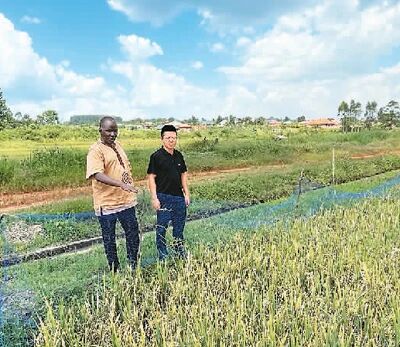
Yunnan University researcher (right) discussing breeding with Jimmy
Jimmy Lamo is the project leader for cereals (maize and rice research) and a rice breeder at the National Agricultural Research Organization of Uganda. He has worked on perennial rice breeding for many years. Jimmy first encountered perennial rice in 2018, when he joined a research collaboration with Professor Hu Fengyi’s team. “It was a very novel variety—plant once, harvest many times—which really fascinated me,” he said. After three years of effort, Jimmy helped the perennial rice PR107 from China obtain variety rights approved by Uganda’s crop authority, laying the foundation for its promotion in Uganda.
To promote perennial rice in Uganda, Jimmy devoted tremendous effort. “At first, local farmers didn’t believe that rice could be sown once and harvested multiple times. Whenever I mentioned this feature, they found it hard to believe,” he said. “So I told them I had been researching this variety for many years—it’s a new variety and new planting technology introduced from China.”
Now, with the efforts of BGI Group’s Africa team, perennial rice has become increasingly well known and accepted across Africa. In 2023, the perennial rice promotion project in Uganda was listed among the practical cooperation projects of the Third Belt and Road Forum for International Cooperation, and in December of the same year it was included in the African Union’s agricultural technology promotion framework, becoming part of the AU Seed and Biotechnology Programme 2024–2025. “Perennial rice yields are higher than our local rice. With this technology, we will surely see a bumper harvest,” Jimmy said.
Beyond the technology itself, Jimmy was also deeply impressed by his Chinese colleagues. Having worked with Chinese agricultural experts for many years, he noted that they are rigorous and meticulous at work, yet warm and friendly in daily life. Through cooperation on the perennial rice project, Jimmy and his Chinese counterparts became close friends. He said, “During trial planting, Chinese experts taught local farmers step by step—land preparation, transplanting, pest and disease control. I could feel that they genuinely wanted to help us. In daily life, we communicate frequently and often visit each other. Perennial rice has not only brought us good harvests, but also strengthened our friendship.”
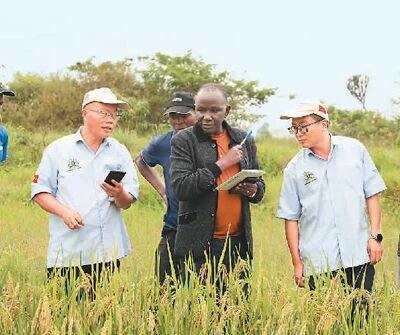
In April, Jimmy (third from left) and BGI agricultural experts conducting breeding evaluation
| “Perennial Rice Will Significantly Improve Local Farmers’ Livelihoods”
The vivid stories of perennial rice taking root in Africa provide a powerful testament to pragmatic China–Africa agricultural cooperation and clearly demonstrate that mutual benefit and win-win outcomes are its defining features.
Kamkama Caleb from Uganda once worked as a geography teacher. In 2017, he joined a China–Africa agricultural cooperation project, and in 2019 he came to Burundi as a marketing manager. “Perennial rice is still in its early stages, but I can already see the expectations of the Burundian people for this new variety,” Caleb said. “I am very optimistic about its future market prospects in Burundi. In the foreseeable future, perennial rice will significantly improve local farmers’ livelihoods.”
Prudente Ntar Mahoromeza, Burundi’s national project director, said that perennial rice not only simplifies rice production processes but also greatly increases yields. Trial field results show that the first season’s yield is twice that of traditional Burundian rice. With further optimization and promotion of cultivation techniques, he looks forward to expanding planting areas nationwide.
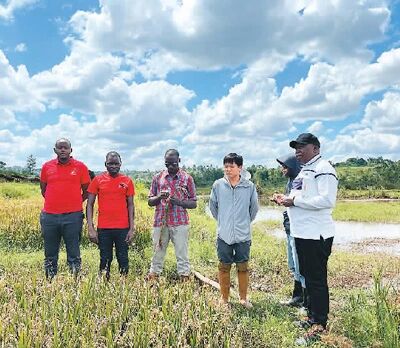
In May, the Director of Burundi’s Variety Approval Bureau (far right) inspecting perennial rice growth
The successful cultivation of perennial rice in Burundi not only brings stable income to local farmers, but also strengthens the foundation of food security in Africa. As an innovative “light and simplified” rice farming model, its greatest advantage lies in reducing production steps and costs, thereby significantly improving agricultural efficiency. The vision of “food for all and savings for all” is gradually becoming a reality in Burundi.
“Africa has vast land and abundant resources. Beyond grain, China and Africa also have cooperation potential in industries such as coffee and fisheries. I believe China–Africa cooperation will become ever closer, bringing more opportunities to both sides,” Jimmy said.