
Tracing the Origin of Chinese Soybeans! BGI Wanwu Joins the Soybean Industry High-Quality Development Sci-Tech Research Consortium
Source:BGI Bioverse View count:23444
From September 28 to 29, the series of events themed “Tracing the Origin of Chinese Soybeans · Co-building a New Highland for a High-Yield, High-Efficiency Soybean Industry Along the World’s Golden Soybean Planting Belt at 48°N, 49°N, and 50°N” was held in Nenjiang City, Heilongjiang Province. The event was initiated by Beidahuang Jiusan Grain and Oil Industry Group Co., Ltd. and hosted by the CPC Nenjiang Municipal Committee and the Nenjiang Municipal Government. As a core member unit of the consortium, BGI Wanwu was invited to attend and signed the strategic cooperation agreement of the sci-tech research consortium.
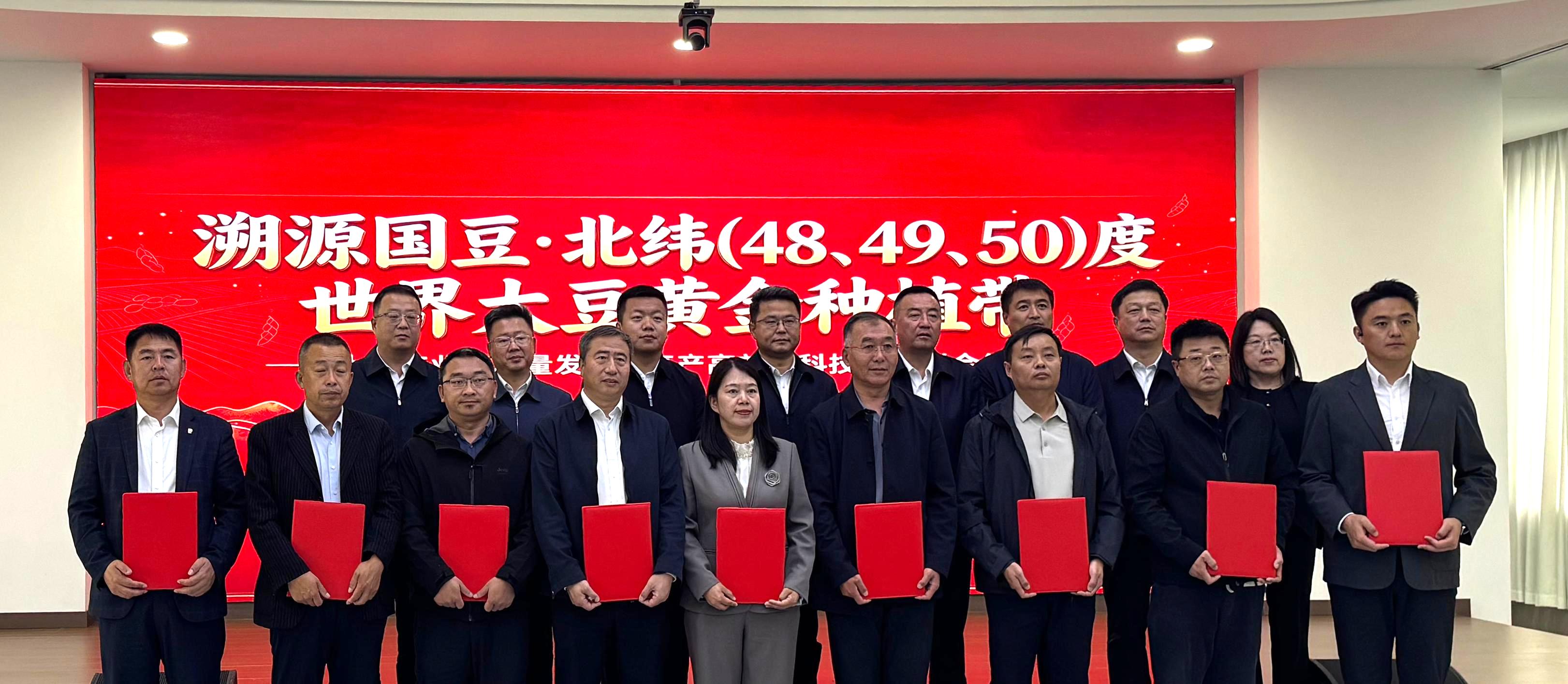
(Representatives of member units of the sci-tech research consortium jointly unveil the consortium and sign the agreement.)
Nenjiang, endowed with premium resources from one of the world’s three major black soil belts, is a core advantageous production area of China’s soybean industry. Its soybean planting area and output both rank first among all counties nationwide, making it a well-deserved “golden coordinate” for Chinese soybeans. Tracing the origin of Chinese soybeans traces not only the origin of the species, but also the root of the industry and the chain of development. China is the only globally recognized origin of soybeans. Yet today, this species that has nourished the Chinese nation for thousands of years faces a stark reality: insufficient soybean self-sufficiency and high external dependence.
At the event, key industry units including Beidahuang Group Jiusan Branch, Longping High-Tech Co., Ltd., Lianhe Huinong Agricultural Materials (Beijing) Co., Ltd., and Shenzhen BGI Wanwu Technology Co., Ltd. jointly unveiled the Soybean Industry High-Quality Development Sci-Tech Research Consortium. The nine core entities each leveraged their respective strengths and worked in synergy, with business covering key links across the entire industrial chain, including scientific research, improved seed breeding, high-yield cultivation, and industrial empowerment. This marked the formal formation of a full-chain collaborative network for domestic soybeans linking “from seed to table and from field to market,” and established a core platform for the large-scale, standardized, and science-driven development of the industry.
During the representatives’ exchange and speeches, Liu Huan, CEO of BGI Wanwu, delivered a keynote presentation titled “Life Sciences Empowering the High-Quality Development of the Soybean Industry.” He introduced that BGI Wanwu is the core smart agriculture unit under BGI Group. Relying on core genomics technologies, it focuses on two core areas: seed industry innovation and agricultural microbial resource development, empowering the high-quality development of modern agriculture with cutting-edge biotechnology.
He said that BGI’s connection with soybeans dates back a long way. In 2010, BGI, together with The Chinese University of Hong Kong and other institutions, completed the world’s first population genome resequencing of wild and cultivated soybeans under the project “Soybean Homecoming,” with the results published as a cover article in Nature Genetics. In 2020, BGI, together with the CAS Center for Excellence in Molecular Plant Sciences and other institutions, revealed the mechanism by which arbuscular mycorrhizal symbiosis regulates the rhizosphere microbiome and promotes legume–rhizobia symbiosis; the results were published in Molecular Plant. In 2024, BGI and other institutions, based on a more than 40-year long-term positioning experiment in the Harbin black soil region, clarified the mechanism by which the rhizosphere microbiome maintains soybean productivity and screened a growth-promoting synthetic microbial community; the results were published in Nature Communications.

Today, based on the dual needs of black soil protection and soybean quality and yield improvement, BGI Wanwu leverages the results of large-scale digital surveys of black soil to precisely identify high-efficiency functional strains, develop compounded dedicated microbial agent product series, and conduct large-scale demonstration applications in soybean-producing areas of Northeast China’s black soil region. In 2024, BGI Wanwu, together with 16 Beidahuang farms, conducted the first 10,000-mu controlled trial of microbial agent application. Soybean yield increased by 8.9%–15.4% compared with control fields, validating in the first year the green path of “nourishing soil with microbes and reducing fertilizer while increasing efficiency.”

In 2025, the soil digitization project completed the collection of 5,600 black soil samples, covering 17 million mu of black soil farmland, and built a refined soil fertility assessment model, providing data support and improvement solutions for black soil protection and sustainable utilization. The application of the “Huayi” series of microbial agents expanded to 130 demonstration sites in 42 counties and cities across 14 provinces nationwide, with an average soybean yield increase per mu of 8.9%–17.4%.

In 2026, BGI microbial agents have been applied to more than 1.5 million mu of various crops in 89 counties and cities across 21 provinces nationwide. Among them, a 128,000-mu soybean demonstration field at Beidahuang Hongxinglong Youyi Farm increased yield by 51.6 jin per mu compared with conventional control fields, with a yield increase rate of 12.4%. At present, related technology products have been applied at scale in soybean-growing areas of Northeast China’s black soil region, effectively improving soil, stabilizing yields, and improving quality, truly realizing the full potential of soybean cultivation in black soil with Chinese germplasm, Chinese technology, and Chinese solutions.
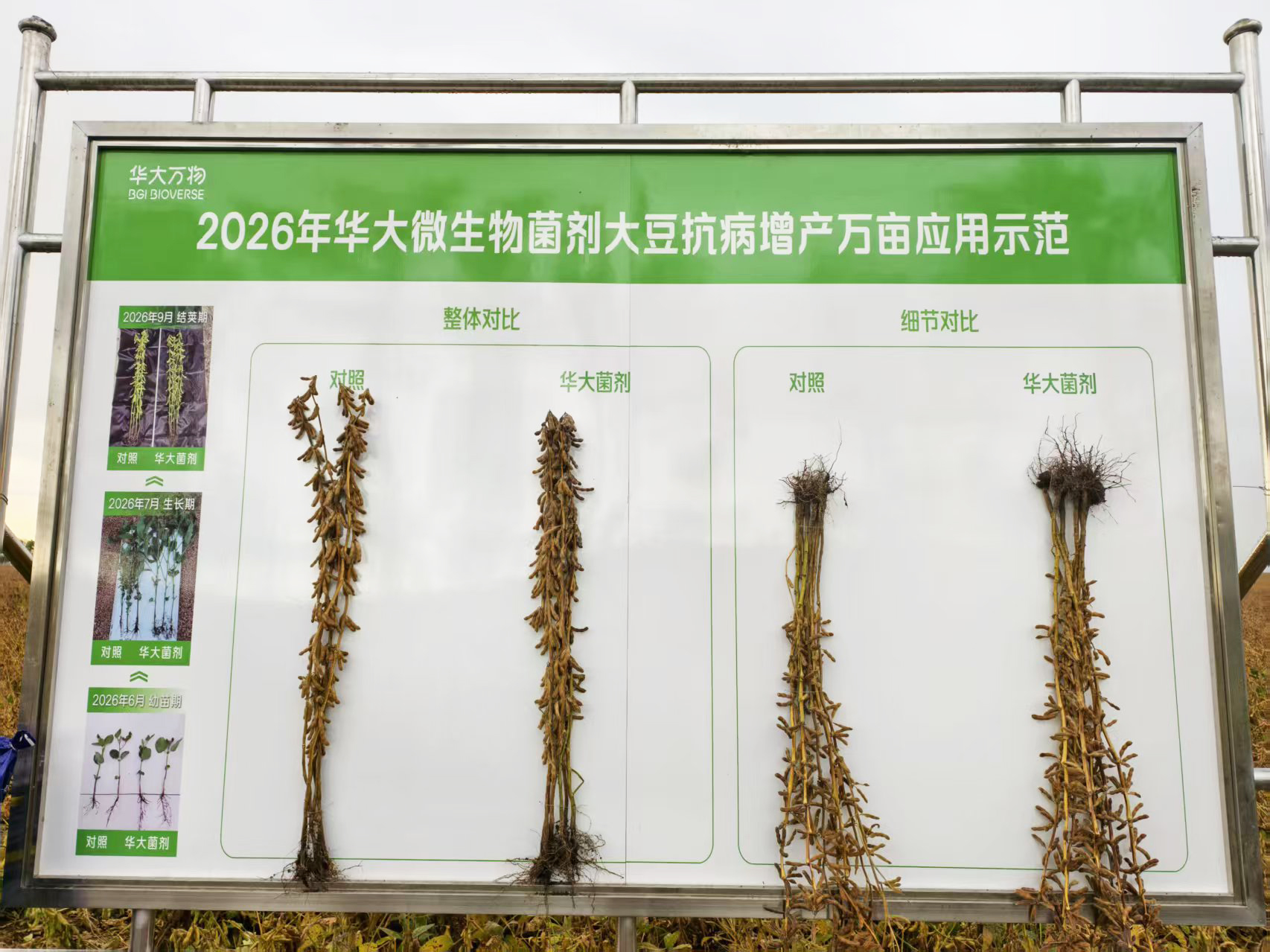
(With the application of BGI microbial agents, soybeans show uniform growth, full pods, and dense root nodules.)
Tracing the origin of Chinese soybeans means returning to the roots of Chinese soybeans—from germplasm resources to cultivation technologies, from scientific research to the industrial system—to re-examine and fully unleash the potential of domestic soybeans and embark on a self-controlled path to revitalize “Chinese soybeans.”
Starting from Nenjiang, this scientific and technological effort around the soybean industry is transforming the resource advantages of the “golden planting belt” into the technological and industrial advantages of “golden yields.” With its technological accumulation in genomics and soil life big data, BGI will join hands with all parties in the consortium to contribute innovative strength to the upgrading and quality improvement of Heilongjiang’s soybean industry and to national food security.

(Inspecting high-yield research and demonstration plots at Daxijiang, Jianshan, and Rongjun Farms of Beidahuang Group Jiusan Branch.)