



June 8 is World Oceans Day. This year’s theme, “Reimagine: Beyond the world we know, a new relationship with our ocean,” invites us to see the ocean not only as a vast body of water, but as a living system full of connections we are still learning to understand. From fish that shape marine ecosystems, to microorganisms that drive carbon and nutrient cycles, to deep-sea life adapted to darkness and high pressure, the ocean holds a remarkable share of Earth’s biodiversity — and asks for a more informed, respectful relationship.
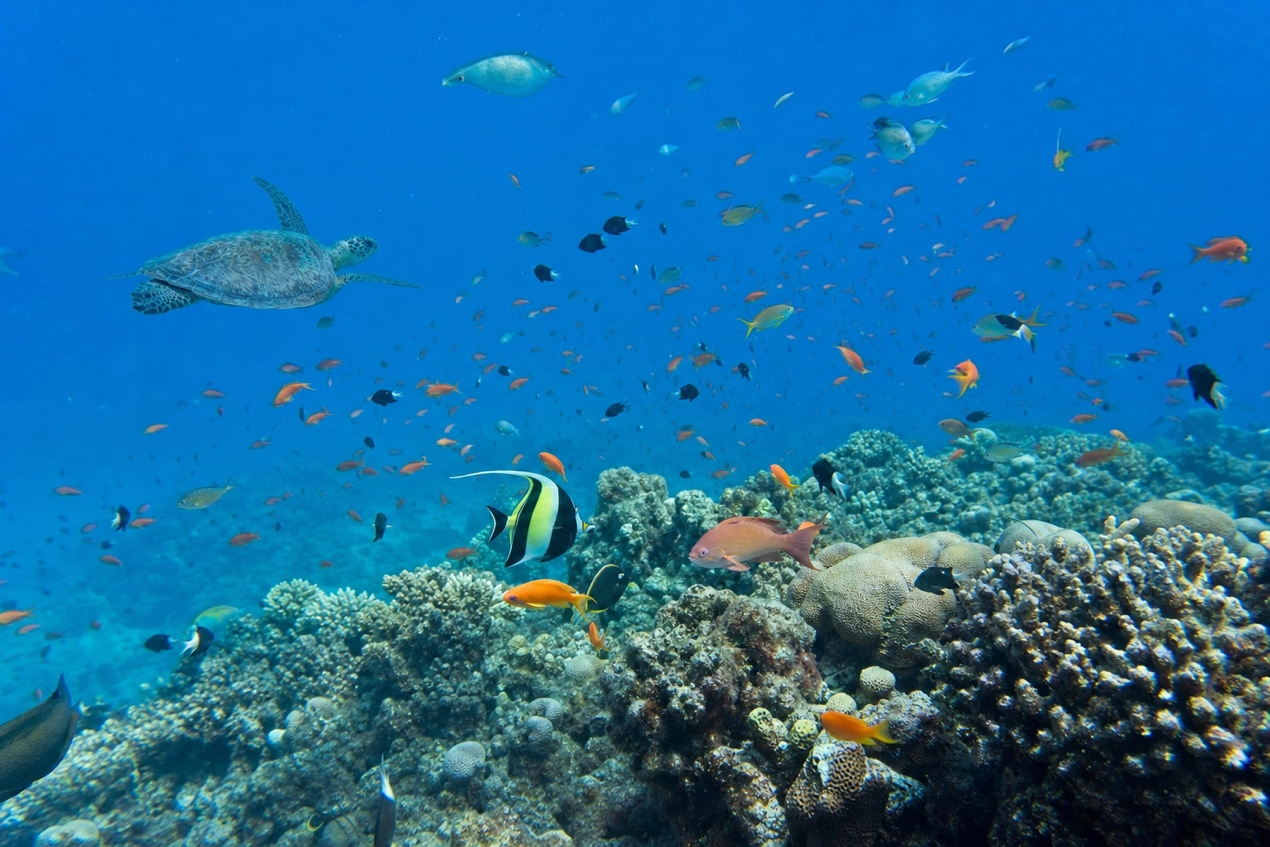 Ocean not only as a vast body of water, but as a living system full of connections we are still learning to understand. (AI-generated Image)
BGI Group has long been involved in global biodiversity research, combining cutting-edge omics technologies, bioinformatics and international collaboration to decode life on Earth. Its work spans a broad spectrum of areas, from genome sequencing across the tree of life, endangered species conservation, extreme-environment biology, to building open-access databases and technology sharing. In marine and fish research, these efforts are helping scientists better understand how ocean life evolved, how it adapts, and how it can be protected.
A key part of this work is BGI’s participation in major international scientific initiatives, including the Earth BioGenome Project (EPB), the 10,000 Fish Genomes Project (Fish10K), the Bird 10,000 Genomes Project (B10K) and the 10,000 Plant Genomes Project (10KP). Through its self-developed sequencing platforms, BGI has helped decode genomes for more than 6,700 animal and plant species. For several groups, including fishes, BGI has contributed more than half of the genomes generated globally to date, providing important resources for studies of species origins, adaptation and conservation.
Fish genomics is especially important for ocean science. Fish are among the most diverse vertebrates on Earth and are closely connected to food security, aquaculture, ecosystem health and sustainable fisheries. Through Fish10K and related collaborations, BGI helps build genomic resources that allow researchers to reconstruct fish evolution, identify genetic mechanisms behind environmental adaptation, and support more science-based conservation and breeding strategies.
BGI has also explored life in extreme environments, including polar regions and the deep sea. These habitats are difficult to access, and each sample is valuable. Genomic and multi-omics studies can reveal how organisms, such as Antarctic krill, survive under pressure, cold, darkness and other challenging conditions. BGI has also used ancient DNA technology to help reconstruct biological community changes along Antarctica’s Ross Sea coast over the past 6,000 years, offering a longer view of how polar ecosystems have changed through time.
Another important tool for ocean protection is environmental DNA, or eDNA. Built on sequencing platforms, eDNA technology can detect species composition and ecosystem changes from environmental samples, helping monitor biodiversity, identify invasive species and support more timely ecological management.
Marine research cannot be done by one country or institution alone. BGI promotes international collaboration through shared technologies, joint platforms and local capacity building, including cooperation with partners in biodiversity-rich regions such as Southeast Asia and Africa.
As biodiversity genomics research advances from sequencing single reference genomes to constructing multi-omics maps of life, and as AI becomes more deeply integrated into data mining, ocean science is entering a new era. BGI continues to use cutting-edge omics technologies to deepen our understanding of marine ecosystems, drive conservation efforts, and foster a more sustainable relationship between humanity and the blue planet.