



Recently, the "Deep Ocean Microbial Symbionts (DOMS)" project (Project No. 151.9), spearheaded by BGI-Research, was officially approved by the Intergovernmental Oceanographic Commission of UNESCO (IOC-UNESCO) and endorsed as a project of the UN Decade of Ocean Science for Sustainable Development (2021–2030) (the "Ocean Decade"). The DOMS project will be fully implemented under the framework of the Ocean Decade Programme No. 3.6, "Deep Ocean Microbiomes and Ecosystems (DOME)", serving as a crucial research unit within this premier international scientific initiative.
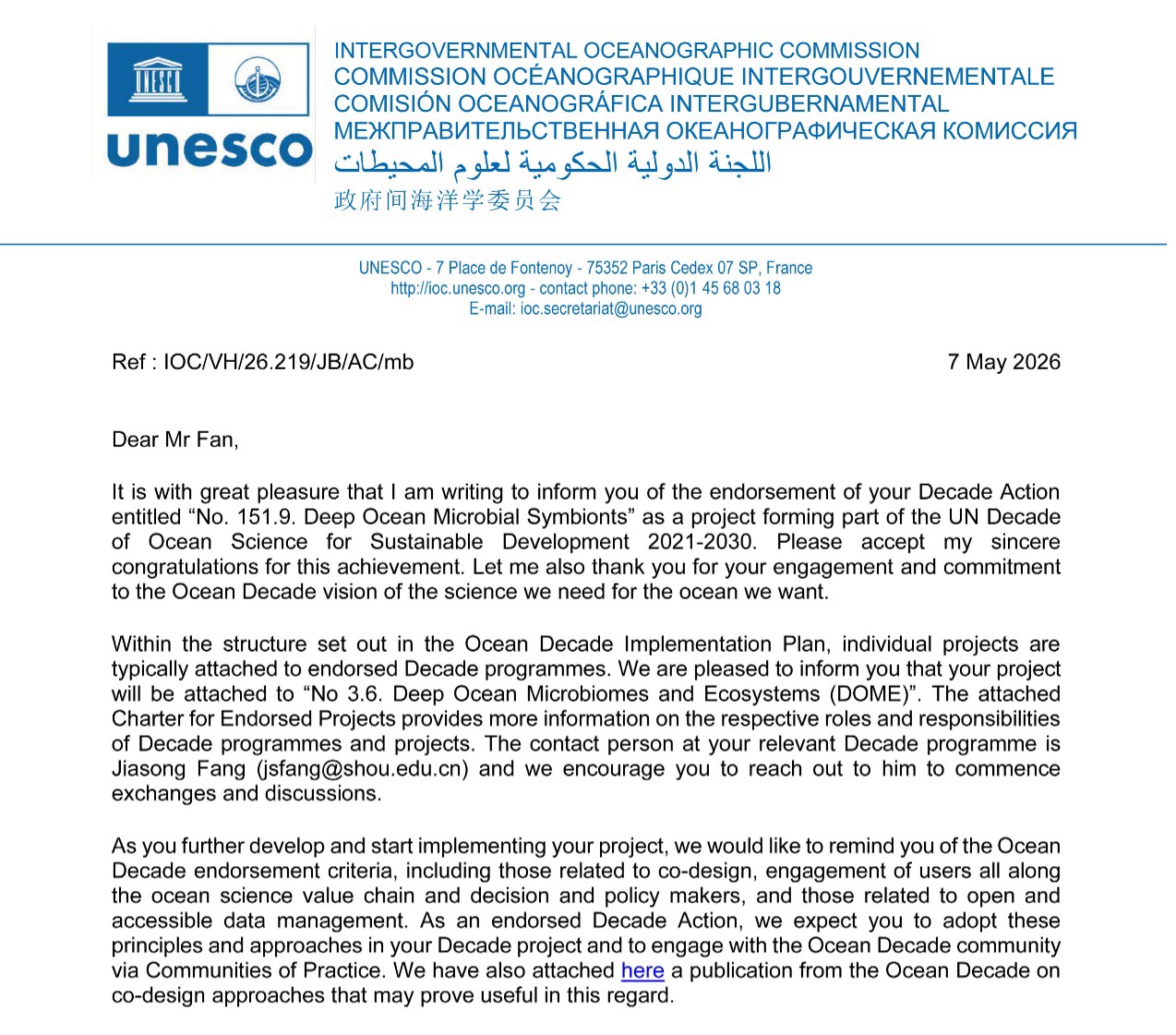 Letter of endorsement to BGI-Research.
Exploring Life in Deep Blue
The DOMS project aims to systematically discover and characterize the taxonomic and functional diversity of microbial symbionts associated with various deep-sea animals (e.g., sponges, corals, mollusks, crustaceans) on a global scale using state-of-the-art molecular and multi-omic technologies. The project will rely on BGI's advanced sequencing platforms to conduct multi-dimensional analyses of deep-sea symbionts. This will not only profoundly enrich our understanding of the deep ocean genome but also holds the promise of discovering novel marine genetic resources with significant industrial and pharmaceutical translation value, such as new enzymes and antimicrobial peptides.
Championing Open Science, Global Collaboration and Data Sharing
As a UN Ocean Decade project, DOMS shoulders the heavy responsibility of promoting fairness and sustainable development in global ocean science. The project pledges to strictly follow the FAIR (Findable, Accessible, Interoperable, and Reusable) and CARE (Collective benefit, Authority to control, Responsibility, and Ethics) principles. All generated genomic data, analysis results, and scientific knowledge will be fully and openly shared globally through the DOME Programme's "OceanMicrobe" platform. To achieve this ambitious goal, the DOMS project has gathered top-tier domestic and international collaborative forces.
Core partner institutions include leading marine research organizations such as the Institute of Oceanology, Chinese Academy of Sciences (IOCAS), Ocean University of China (OUC), Yellow Sea Fisheries Research Institute of the Chinese Academy of Fishery Sciences (YSFRI), and the University of East Anglia (UEA) in the UK. In addition, DOMS will actively integrate into the DOME Programme's capacity-building frameworks (such as iCAN and WECAN) to provide deep-sea research training and collaboration opportunities for developing countries and young female scientists.
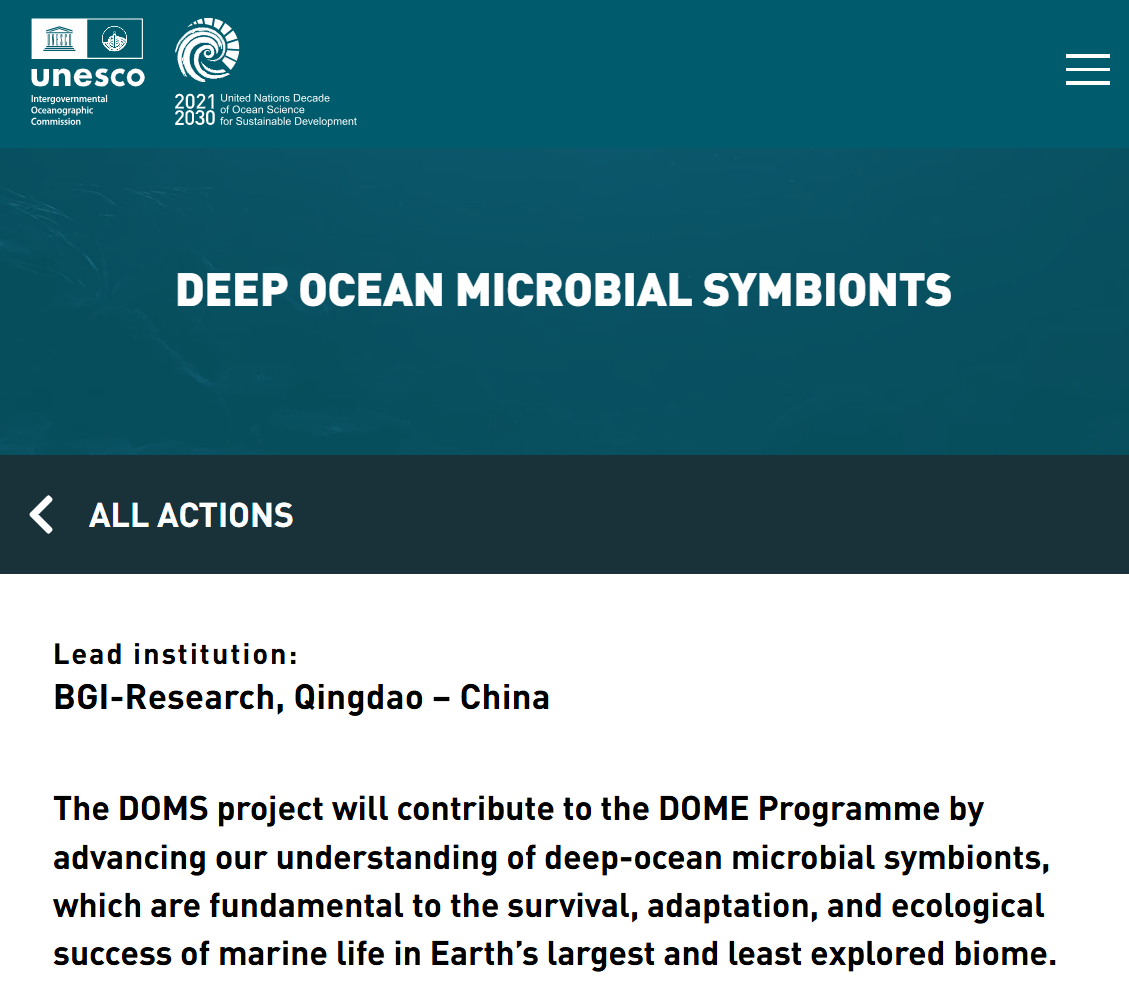 The "Deep Ocean Microbial Symbionts (DOMS)" project webpage on the UN Ocean Decade official website.
Deepening Deep-Sea Omics, Cultivating Scientific Excellence
The successful integration of the DOMS project into the UN "Ocean Decade" is deeply rooted in BGI's long-term strategic layout and robust scientific accumulations in marine science and deep-sea exploration.
In deep-sea expedition practices, BGI has been deeply involved in extreme environment research, such as the Mariana Trench Environment and Ecology Research Project (MEER). Recently, the Institute of Deep-sea Science and Engineering of the Chinese Academy of Sciences awarded bronze medals to Wang Jian, Co-founder and Chairman of BGI Group, and Liu Shanshan, Marine Scientist at BGI-Research. Notably, Wang Jian was also awarded a silver medal as a representative scientist diving in the 70-80 age group. This frontline, hands-on operational model provides core guarantees for the project in acquiring critical samples and first-hand data.
In terms of macro-projects and scientific outputs, BGI has initiated or led multiple internationally influential marine genomics initiatives, including the Global Ocean Microbiome Project (GOMP) and the Ten Thousand Fish Genomes Project (Fish10K). In 2024, the BGI team published milestone findings on global marine microbial diversity and bioprospecting potential in the journal Nature. They successfully discovered novel antimicrobial peptides (AMPs) and plastic-degrading enzymes (PETases) from massive datasets, demonstrating to the world the immense biotechnological translation value of marine "biological dark matter".
Regarding industry standards and norms, BGI, in collaboration with several authoritative domestic institutions, officially released China's first national standard, Requirements for Collection, Processing, and Preservation of Deep-Sea Biological Samples (GB/T 46753-2025), while the corresponding international standard it led, ISO 20309 (Biotechnology-Biobanking-Requirements for deep-sea biological material), has also been officially published. The establishment of this authoritative domestic and international standard system not only fills an industry gap but also provides the most solid standardized technical support for the DOMS project to conduct high-quality deep-sea resource acquisition and scientific sharing on a global scale.
In terms of data infrastructure and underlying technologies, BGI has constructed a series of open data platforms, including the Global Ocean Microbiome Catalogue (GOMC) and the DataBase of Deep-Sea Life (DeepSeaDB), providing massive data resource support for global ocean research. Concurrently, utilizing its proprietary cutting-edge technologies including high-throughput short-read sequencing, long-read sequencing, and pioneering spatiotemporal omics sequencing, BGI has bridged the entire scientific research sectors from multi-dimensional omics sequencing to analysis and interpretation.
In the future, DOMS will work with global partners to jointly illuminate the dark matter of deep-sea life, contributing to "The Science We Need for The Ocean We Want".
What is the UN "Ocean Decade"?
The "UN Decade of Ocean Science for Sustainable Development (2021-2030)" is the most important global ocean science initiative launched by the United Nations for the coming decade. Officially adopted by the 75th UN General Assembly in 2020, it was fully launched in January 2021. The core vision of the Ocean Decade is "The Science We Need for The Ocean We Want". It is not just an international scientific funding and collaborative network, but a transformative policy framework driving global ocean governance, ecosystem protection, and climate change mitigation.
In terms of international policy and influence, the Ocean Decade highly emphasizes open science, equitable sharing of global resources, and capacity development. It requires all endorsed projects to strictly adhere to the FAIR and CARE principles for international data sharing and actively respond to the benefit-sharing spirit of international legal frameworks such as the Biodiversity Beyond National Jurisdiction (BBNJ) Agreement and the Nagoya Protocol. Being endorsed as an official Ocean Decade project signifies that the DOMS team's research not only represents the global forefront of exploring marine biological dark matter but will also wield significant international influence in breaking down scientific barriers, empowering developing nations, and serving the sustainable development and well-being of humanity globally.