



On September 9, BGI Group held its 2026 Global New Product Launch Event at BGI Center in Shenzhen, marking the organization’s 27th anniversary. Under the theme “Intelligent Life · Infinite Health,” the event presented a series of new technologies across brain science, research computing, medical testing, active health management, companion animal health, and agricultural ecology.
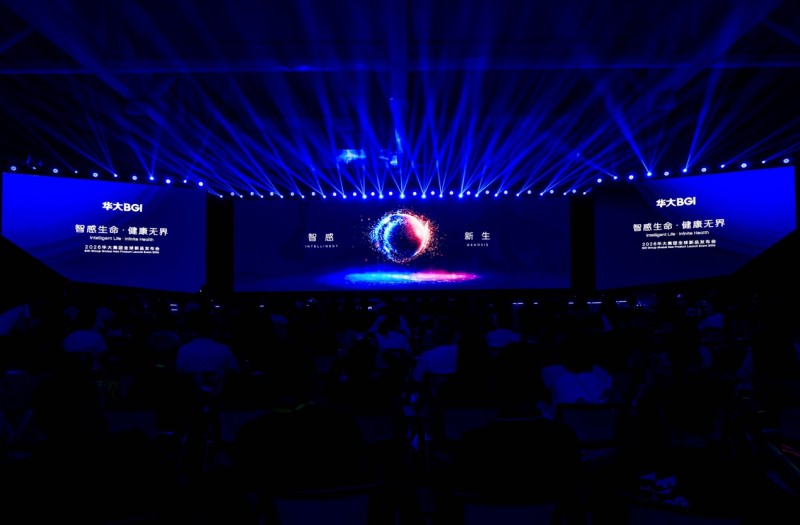 BGI Group 2026 Global New Product Launch Event venue.
The event reflected a broader direction in life sciences: using genomics, multi-omics, artificial intelligence, automation, and wearable technologies to make biological signals more visible, measurable, and actionable. Rather than offering a single answer for everyone, these technologies aim to identify individual differences first, then support more precise decisions in research, health management, nutrition, skincare, animal health, and soil ecology.
 Wang Jian, Co-founder, Chairman of the Board of BGI Group, speaks at the event.
At the event, Wang Jian, Co-founder, Chairman of the Board of BGI Group, said that looking to the future, BGI will remain guided by health, supported by more advanced and more accessible life science tools and genomic foundation models, and continue to promote the deep integration of life sciences and clinical medicine. He noted that BGI will continue to leverage frontier technologies to contribute to global life and health.
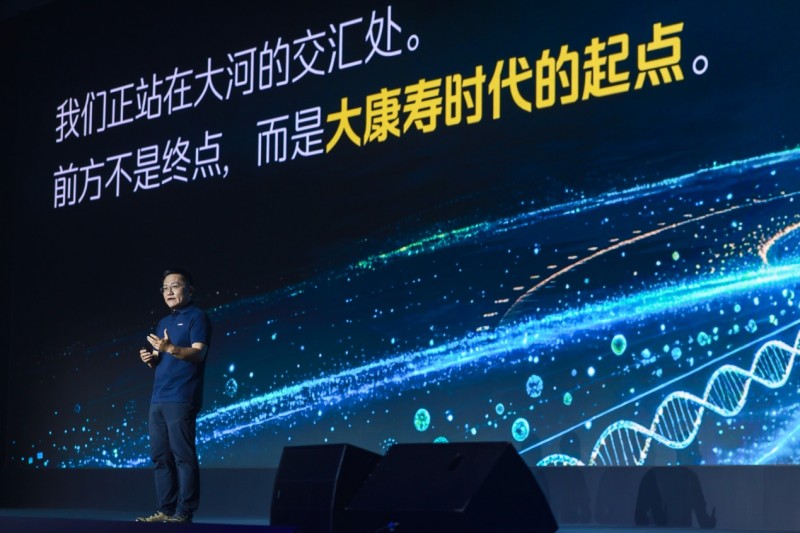 Yin Ye, CEO of BGI Group, delivers a keynote speech.
BGI Group CEO Yin Ye then delivered a keynote address titled “The Era of Great Health and Longevity.” He said that, after the rapid rise of AI, longevity engineering may become the greatest opportunity for humanity - and even for carbon-based life. He emphasized that “great health and longevity” is not simply about living longer, but about living better, healthier, and with greater dignity. He also called for a shift from treating existing diseases to preventing diseases before they occur, and from passive medical care to proactive health management.
Dr. Yin also stressed that “a health checkup is the starting point for improving health, not the end point.” Only by continuously accumulating and tracking health data, he said, can people understand changes in their bodies earlier and turn health into actions they can take every day.
A Multimodal Brain-on-Chip System for Brain Science Research
Brain science was one of the key frontier areas highlighted at the event. Among the technologies unveiled was the multimodal brain-on-chip interaction system - BGI’s first product in the field of the origin of consciousness, and also the world’s first multimodal product in this field, filling an important gap in the industry.
For the first time, the system integrates on-chip in situ cultivation of neuronal cells, neural tissues, and brain organoids, together with electrophysiological functional interaction and optical functional interaction on a single platform. By enabling the full process of “cultivation–recording–modulation” on one chip, it allows researchers to conduct long-term, continuous, precise, and multimodal observation and regulation of the same sample.
The system provides a new technology platform for research in areas such as brain organoid development, neurological disease modeling, neuropharmacological screening, and frontier biological intelligence.
From the microscopic activity of brain organoids to the dynamic changes in each individual’s physical condition, BGI’s exploration of life signals also extends to the improvement of personal health.
Measuring the Body Beyond Chronological Age
The event also highlighted how biological data can support a more dynamic understanding of human health.
Built on BGI’s 133111i active health technology platform, digital health tools presented at the event are designed to move health assessment from one-time testing toward continuous management. A key starting point is understanding inherited biological information. BGI introduced technologies that combine long-read and short-read genome sequencing to build long-term biological profiles for families, covering inherited disease risks, cancer-related risks, complex disease susceptibility, pharmacogenomics, ancestry, and physical traits.
Beyond inherited information, the body is constantly changing. BGI presented a health index framework that integrates multi-source physical examination data to quantify an individual’s overall health status. Blood-based epigenetic analysis can examine approximately 28 million DNA methylation sites to assess the biological age of eight major organs and multiple health dimensions, while immune profiling based on the Chinese Immune Multi-Omics Atlas (CIMA) evaluates an individual’s immune age.
These approaches make it possible to look beyond the age printed on an ID card. Changes that people may previously describe only as “not feeling well lately” can become indicators that are tracked over time, helping to show whether lifestyle adjustments are associated with changes in aging-related metrics.
BGI also presented an AI-powered multimodal eye imaging system that integrates external eye imaging, fundus photography, OCT/OCTA, biometry, and eye-movement tracking. The system is designed to complete a one-stop auxiliary assessment of eye and multi-system health risks within five to seven minutes. In addition, a wearable smart ring was introduced to continuously record cardiovascular, sleep, activity, and recovery-related signals through daily use, supporting 24-hour passive monitoring and the development of personal digital health records.
From Broad Supplementation to More Targeted Nutrition
Nutrition was another area where the event emphasized the value of individual data.
Many people take broad-spectrum supplements without knowing whether they actually need all of the ingredients. BGI presented a new approach that uses whole-genome testing and metabolomic testing as the entry point. Based on a self-developed dual-baseline model, individual data are compared with a longevity baseline from 129 Chinese centenarians and a natural population baseline from more than 10,000 healthy individuals. Algorithms then generate personalized nutrition formulations.
After the formulation is generated, flexible manufacturing allows tablets to be produced according to individual needs, with a minimum additive precision of 5 milligrams. The formulation can also be divided into morning and evening doses based on biological rhythms.
The approach is intended to make nutritional support more targeted and adjustable, moving from “more ingredients” to “what is needed, and how much is needed.”
Reading the Skin Before Choosing a Skincare Solution
The same logic of personalization was also applied to skin health.
BGI presented a skin health management system that combines genetic, metabolic, and optical testing. By analyzing 56 key genetic sites and 243 skin classification indicators, the system is designed to better understand the inherited tendencies and acquired changes behind common skin concerns such as pigmentation, wrinkles, dryness, sensitivity, and dullness.
Based on multi-omics skin data, algorithms match individuals with suitable formulations from 160,000 possible combinations. The plan can then be adjusted dynamically through quarterly reassessment.
This reflects a move away from choosing skincare based mainly on popular ingredients or online recommendations, and toward a model that starts with understanding the biology of each person’s skin.
Extending Precision Life Science to Pets and Soil
The event also showed how personalized life science technologies can extend beyond human health.
For companion animals, BGI presented a pet precision health management solution brings genetic analysis and pathogen screening into everyday pet care. The solution includes a pet DNA test with more than 20 analysis modules, covering breed and lineage analysis, nutritional-requirement analysis, comprehensive genetic disease screening, and breeding guidance. It also features a pet pathogen test, which provides high-throughput screening capable of detecting more than 30,000 pathogens within 24 hours. By delivering personalized, science-driven insights, this solution empowers pet owners to better understand and manage their pets’ health, supporting a shift from post-symptom diagnosis to comprehensive health evaluation and proactive health intervention.
In agriculture, BGI introduced an intelligent eco-soil system. Drawing on more than 100,000 soil microbial samples, over 30,000 functional microbial strains, and more than 350 TB of microbial genomic data, the system evaluates soil health across six dimensions, including nutrient composition and physicochemical properties, pesticide residues, microbial diversity, beneficial bacteria abundance, and pathogen load. The system can then match corresponding crop lifecycle nutrition solutions for different plots of land, supporting a shift in soil health management from experience-based judgment to data-driven precision.
Across people, pets, and soil, the shared principle is the same: avoid a single template, identify differences first, and then look for a more appropriate solution.
Making Life Science Tools Smarter
For life science research, BGI presented an intelligent multi-omics platform that unites cloud computing, massive biological datasets, and domain-specific AI to streamline discovery. Through simple natural-language interaction, the system automates the entire research lifecycle - spanning literature review, instant dataset search and retrieval, pipeline execution, and interactive reporting - eliminating the need for coding, dependency troubleshooting, or manual environment setup. By embedding thousands of validated, peer-reviewed bioinformatic skills and standardized workflows, it guarantees fully traceable and reproducible results - allowing researchers to bypass technical bottlenecks and focus entirely on scientific insights.
Strategic Partnerships Advance Intelligent Health and Life Science Innovation
The event also featured the signing of multiple cooperation agreements and launch ceremonies. BGI signed Life Index partnership agreements with institutions including Anhui Provincial Hospital and Guangzhou Baiyun District People’s Hospital, as well as city partnership agreements for BGI Future Intelligent Health Center with organizations including Hubei Big Data Group. In addition, BGI entered into SEQ ALL strategic partnerships with 10 institutions to decode more possibilities of life through full-length sequencing technology. BGI also signed strategic cooperation agreements with the Trustworthy and General Artificial Intelligence Laboratory of Westlake University and the Shenzhen Institute of Advanced Technology, Chinese Academy of Sciences, respectively focusing on embodied intelligence and retinal organoids.
From brain organoids to biological age, and from cloud-based research tools to nutrition, skincare, pet health, and soil ecology, the technologies presented at BGI Group’s 2026 Global New Product Launch Event demonstrate how life science is expanding new possibilities for understanding life and managing health.
Across these innovations, the shared goal is clear: to detect subtle biological signals earlier, prevent complex data from remaining confined to reports, and translate scientific insights into practical actions that support research, decision-making, and everyday health management.
As BGI Group enters its 28th year, the organization will continue to advance genetic technologies and broader life science tools, promoting their wider application in real-world health, clinical, research, and ecological settings, and contributing to the future of intelligent life and infinite health.