



On October 6, investigators at Yazhouwan National Laboratory, BGI-Research, and collaborating institutions reported in Cell a spatiotemporal atlas of rice that records which genes are active, in which cells, and where, from germinating seed to maturing grain. It suggests that one regulator directs different genes in different settings and reveals regional starch and protein programs in the developing grain.
[Online]
The study “A spatiotemporal lifecycle atlas decodes spatial coordination in rice” was published in Cell.
A grain of rice is both food and a seed for the next crop. Understanding how it forms means following the plant from roots and leaves to flowers and grain. Single-nucleus RNA sequencing reads gene activity in individual nuclei, like a census without addresses; spatial transcriptomics, here BGI’s Stereo-seq, reads it on thin tissue sections, like a street map. Building on single-cell and spatial atlases of rice and other crops, this study combines both views across the lifecycle of the japonica variety Zhonghua 11, anchored to a new gap-free genome.
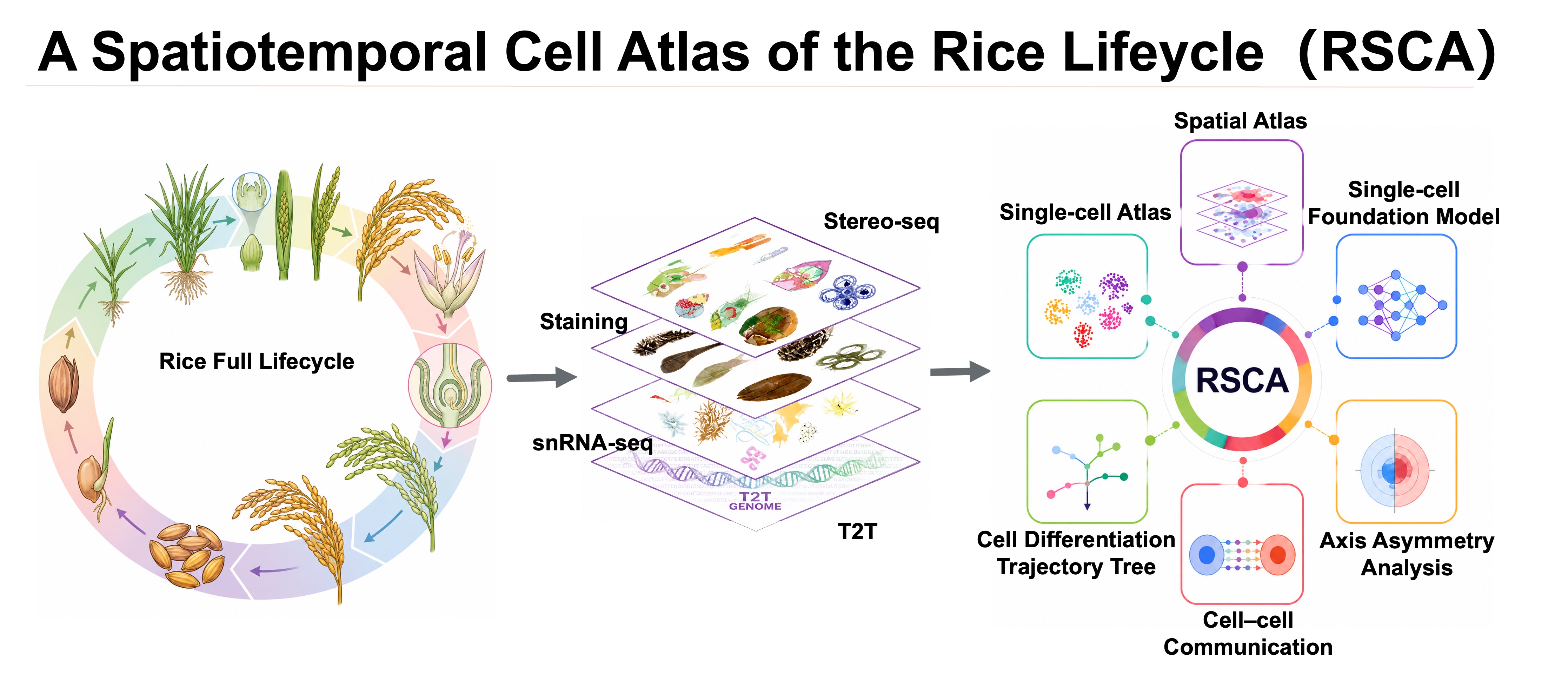
The study combines gene-activity measurements with tissue locations across the rice lifecycle, connecting a whole-plant overview with questions about how cells build the grain and support the next generation.
The atlas spans 10 organ and tissue types and 61 samples covering key developmental stages, comprising 851,725 nuclei and 347,640 spatial bins (position-tagged measurement spots, not a count of cells). The team annotated 119 cell types and 133 subtypes and built an inferred developmental trajectory graph linking cell states from the early embryo to mature organs, a similarity-based roadmap rather than a traced family tree.

Gene-activity maps span 10 organ and tissue types across the rice lifecycle, linking cells to their locations and giving researchers a way to follow how a plant develops from seed to the next harvest.
Changing a gene to improve grain development could also affect roots or flowering, a challenge for breeding useful crops. The atlas offers a way to investigate those connections. OsARF1, a transcription factor that regulates other genes in response to the hormone auxin, was linked to six developmental branches, with largely distinct predicted targets. Mutants lacking it showed changes from germination to seed maturation. In mutants, expression fell for the root-barrier gene OsCIF2 in root tissue and for the sugar transporter gene OsSWEET14 and carbon–nitrogen metabolism-related gene OsGS1;2 in the seed. OsARF1 bound the three genes’ control regions in yeast and test-tube assays and activated reporter genes driven by those regions in tobacco leaves. OsARF1 may act like a manager directing different teams at different sites. Mapping those teams gives researchers specific targets to test.
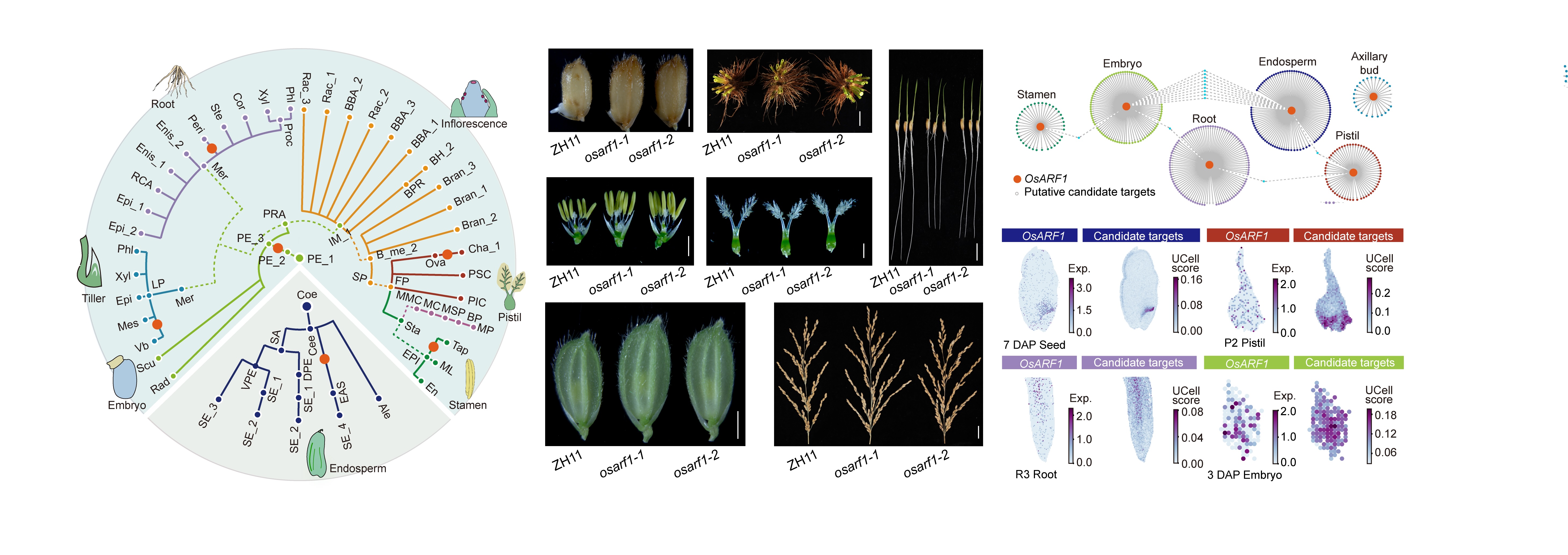
The inferred developmental trajectory map, mutant plants and spatial gene-expression profiles link OsARF1 to several growth processes, illustrating why changing a gene for crop improvement can affect more than one trait.
Inside a developing seed, the embryo, the young plant that can become the next crop, needs nourishment. The seed targets are expressed in the endosperm adjacent to scutellum (EAS), a temporary cell population bordering the embryo’s absorptive tissue. Detected at sampled stages from 5 to 15 days after pollination but not later ones, EAS is where OsARF1 is specifically highly expressed. In OsARF1 mutants, the sucrose transporter OsSWEET14 was significantly downregulated, endosperm became larger, embryos became smaller, and embryonic sugar content decreased, suggesting that OsARF1 regulates EAS sucrose transporters such as OsSWEET14 to pump sugar into the embryo and acts as a gatekeeper of carbon allocation.
The same tissue that stores reserves for the seed also makes up most of the rice we eat. Within this endosperm, the atlas shows where starch and storage-protein programs become active as the grain develops. At 5 to 8 days after pollination, spatial data distinguished gene-expression programs on opposite sides of the outer endosperm, termed dorsal and ventral, which looked alike under the microscope. The dorsal side leans toward starch-related genes and the ventral side toward storage-protein genes, as in situ sequencing confirmed for representative genes. Normal mature grains had larger starch granules dorsally and more glutelin, a storage protein, ventrally. In mutants of the dorsal auxin-synthesis gene OsYUC11 or the ventral glutelin gene OsGluB6, these differences were no longer statistically detected, and the glutelin pattern was sometimes reversed. Both sides still hold starch and protein; like shelves in one pantry, each leans toward a different staple.
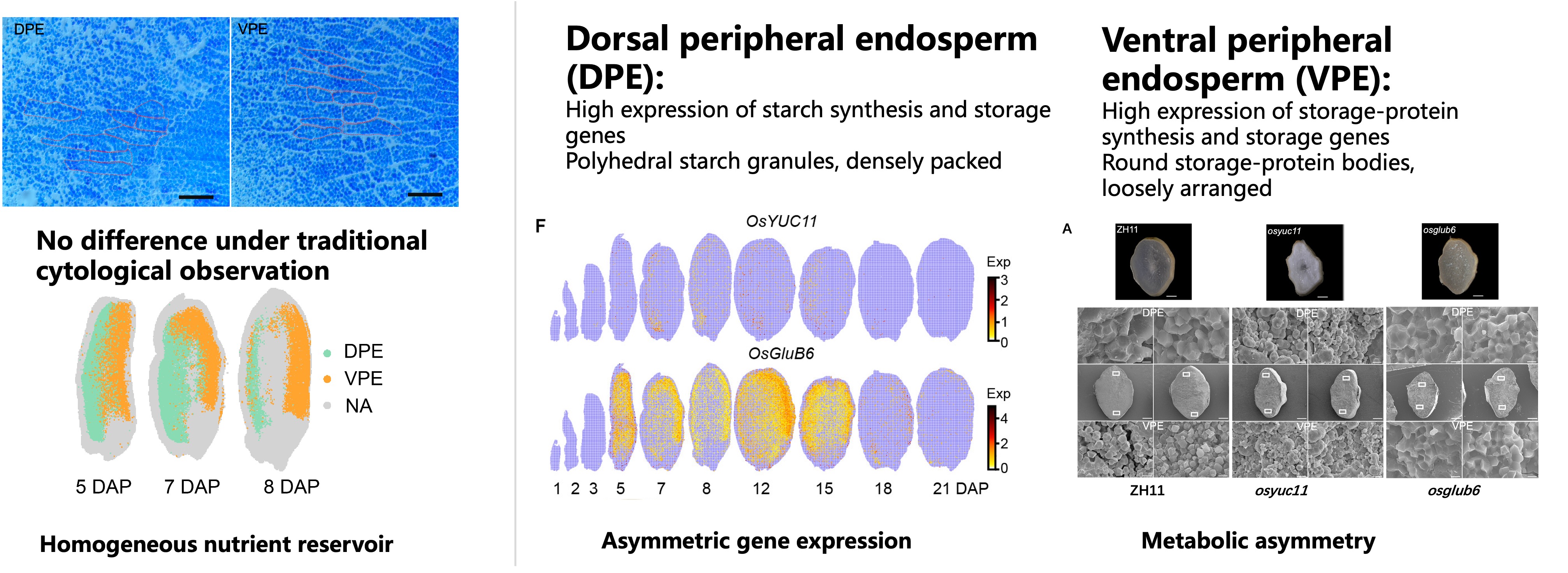
Spatial maps and grain images reveal differences in starch-related and storage-protein programs across the endosperm, connecting local gene activity with the composition of the rice we eat.
These findings can guide further work: researchers can use the Rice Spatio Temporal Atlas portal, built by BGI-Research members, to locate a gene’s activity across tissues and developmental stages. RICE scGPT, a rice-adapted AI foundation model from BGI-Research contributors, enabling the model to learn cellular features and automatically annotate cell types with similar patterns in other studies. BGI-Research teams contributed to nucleus isolation, library construction, data analysis, the proposal of key scientific investigations, and manuscript writing.
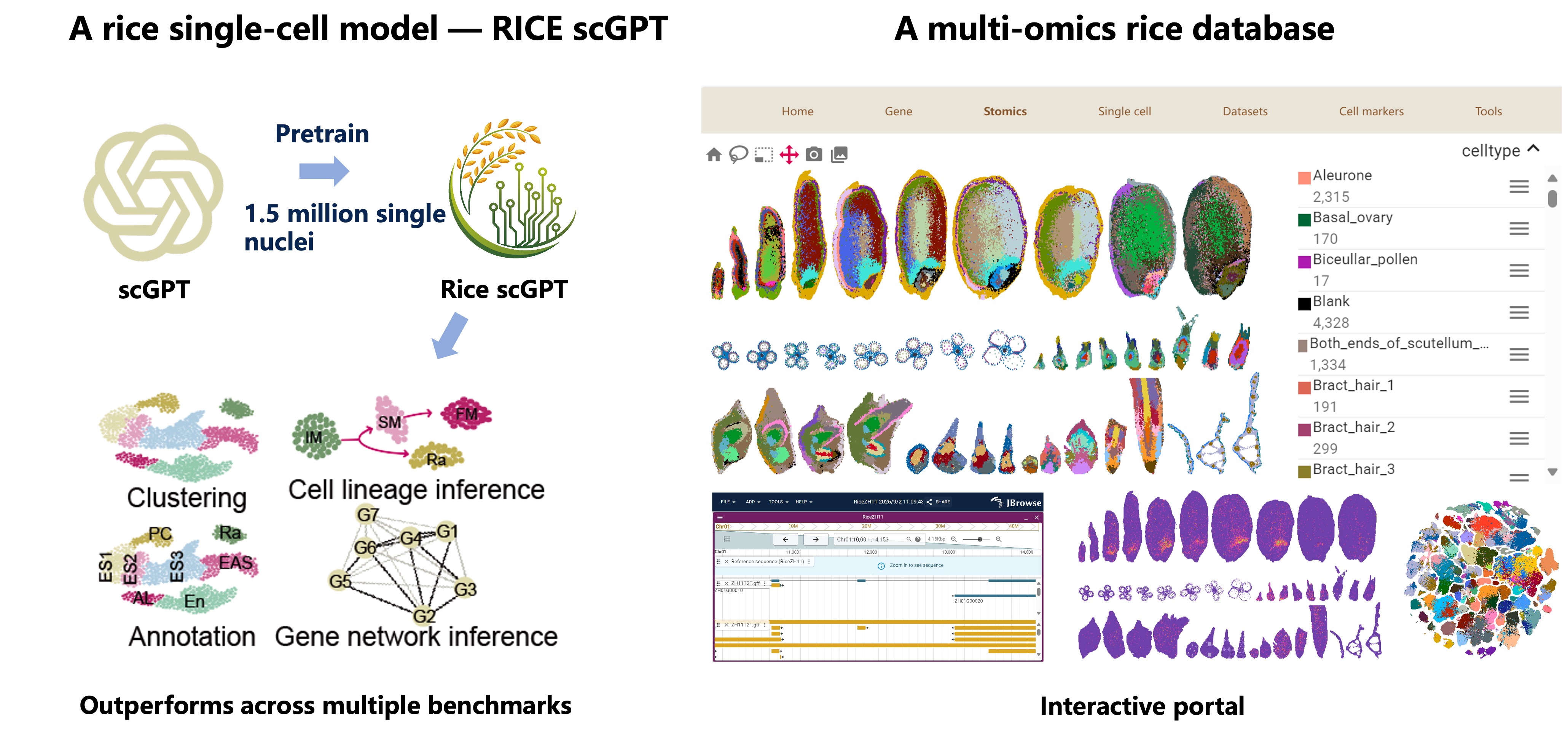
The RICE scGPT model and interactive atlas help researchers identify cells and locate gene activity, making the data reusable for investigating how rice grows and how its grain develops.
For crop science, the authors suggest that targeting downstream, context-specific modules rather than master regulators might one day tune traits such as grain filling with fewer side effects. The regional programs also invite region-by-region study of the grain’s starch and protein balance; testing across other varieties and environments will show how far these ideas carry. Every grain of rice on the table is mostly endosperm; in the rice studied here, the two sides of that tissue followed different molecular programs as the grain filled.
This research can be accessed at https://doi.org/10.1016/j.cell.2026.09.23.