



A decade-plus career. A paralyzed dog. In 2023, Mcdon chose the latter over her career.
When Tiger, her beloved companion of ten years, suddenly couldn't walk, the veteran engineer made a decision that stunned colleagues: she resigned from her job with BGI, packed her bags, and and went in search of a cure for Tiger. That journey transformed her from scientific engineer to influencer—today, Mcdon connects with thousands of pet owners online, sharing the unfiltered reality of pet parenthood.
"I never thought adopting a dog would completely change my life," Mcdon said. Tiger came into her world at just three months old, and for a decade, he was her anchor.
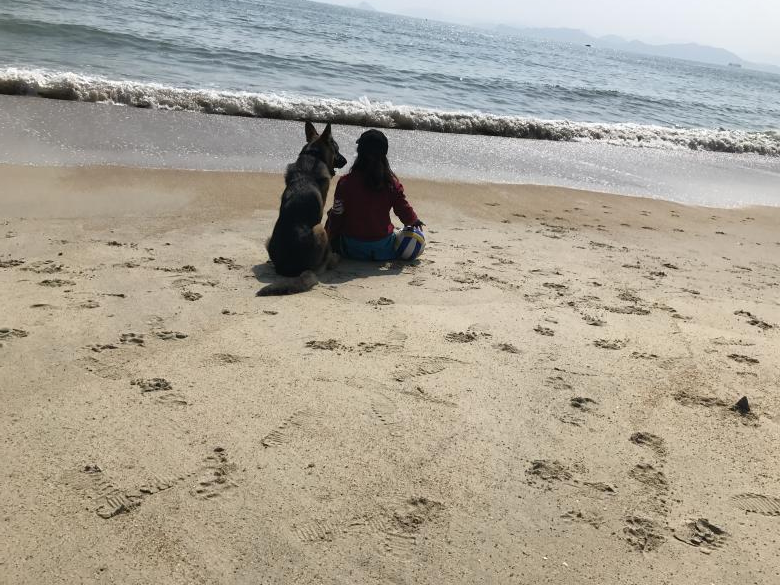
Mcdon with six-month-old Tiger playing by the sea. Credit: Mcdon.
“Then one day in 2023, Tiger's hind legs just gave out. He collapsed and couldn't get up," Mcdon recalled. What seemed like a routine diagnosis—spinal inflammation, some anti-inflammatory drugs, and observe at home—quickly became a nightmare. Over two months, Mcdon took Tiger to more than a dozen clinics. They went through four or five different treatment protocols. Nothing worked. No one could tell her what was actually wrong.
Tiger's condition demanded round-the-clock care. His body had gone completely numb—he'd lost control of his bladder and bowels. "We were literally racing against death," Mcdon said.
There was no question what came next. She quit her job, packed Tiger into her car, and drove over 2,000 kilometers to Beijing in search of answers. For Mcdon, Tiger was never just a pet. He was family. He was a life worth fighting for.
In Beijing, doctors finally found an answer: a herniated disc in Tiger's neck was compressing his nerves, paralyzing his limbs. Surgery followed. Slowly, miraculously, Tiger began to recover.
But recovery wasn't the end of the story. A year later, new complications emerged—including a perineal hernia, a common ailment in aging dogs where deteriorating anal muscles make defecation difficult. Once again, Mcdon found herself on the road to Beijing, searching for the next solution.
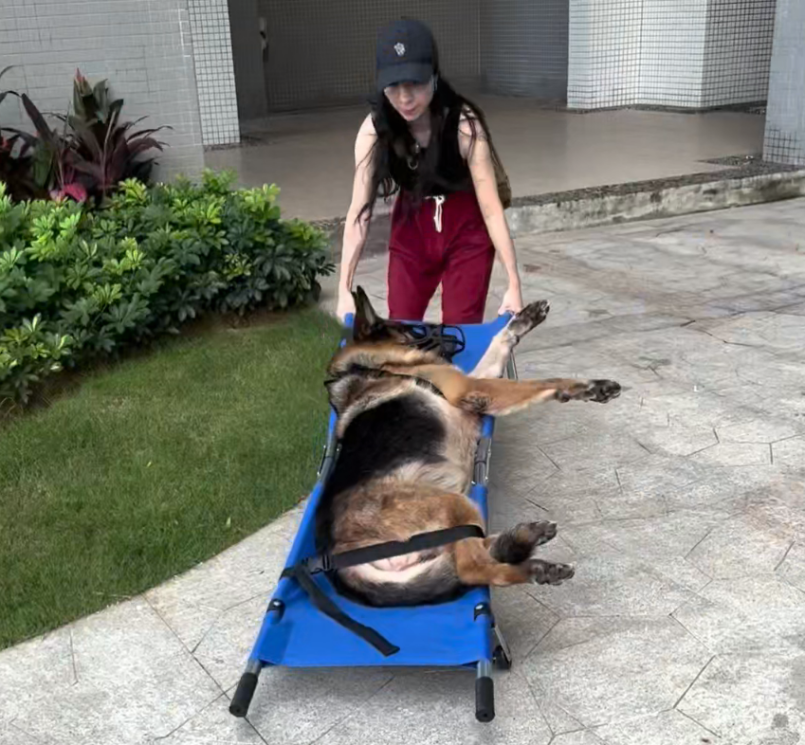
Tiger during his illness. Credit: Mcdon.
In 2025, Mcdon saw something that made excited: her former employer, BGI Group, had just launched a pet genetic testing product. Her mind immediately went back to those grueling months of medical dead ends, when one doctor had suggested genetic testing—but only through a German lab, requiring a painful cerebrospinal fluid extraction, a month-long wait, and a hefty price tag simply just to screen for a single condition.
BGI's offering was a completely different story, requiring a simple saliva swab collected at home, yet one test could screen for 138 canine genetic diseases at a fraction of the cost. Mcdon didn't hesitate—she tested Tiger immediately.
"Honestly, after everything Tiger has been through, I never want him back in a hospital," Mcdon said. "I'm done chasing disease. I want to prevent it."
When the test results arrived, everything clicked into place. Tiger carried the gene for degenerative myelopathy—a condition that predisposes him to herniated discs and nerve compression. The very thing that had paralyzed him. Mcdon had been fighting a battle she didn't even know was coming.
"If I could go back, I'd test him when he was just a puppy. Withearly detection, early intervention he wouldn't have suffered through all those treatments. He could have lived better. He could have had more quality time with me."
Genetic testing, Mcdon has come to understand, is like a physical exam—but one that looks into the future, providing insights that directly guide present-day care. The insights can be life-saving in the most mundane moments.
Take the MDR1 gene mutation, which affects how pets process common medications. Dogs carrying this mutation can't properly metabolize everyday treatments—dewormers, anti-inflammatories, and anti-diarrheal medications. Owners might not notice anything wrong initially, but over time, these seemingly harmless drugs could make pets seriously ill, or even prove fatal. Similarly, genetic testing on malignant hyperthermia identifies pets at risk during anesthesia—turning routine procedures like dental cleanings or X-rays into potential hazards without proper precautions.
"It's about not having to say, 'I wish I had known," Mcdon said simply. "Pets can't speak for themselves. They can't tell us what's wrong, and they can't make choices about their own care. Whether they live long, healthy lives—that's entirely on us."

Tiger after his recovery. Credit: Mcdon.
Mcdon’s years on her career as an engineer had been all about labs, data and science projects. But Tiger's journey showed her something different: how scientific breakthroughs translate into real, breathing lives. How a simple genetic test could mean the difference between a pet's suffering and their wellbeing.
Science, at its best, isn't just measured in data points. It is measured in the lives it touches.