



They say the eyes are the windows to the soul. What fewer people realize is that through these same windows, we can also see a clear picture of our health.
The eye is the only place in the human body where small arteries, small veins, and nerve fibers can be directly observed without any invasive procedure. In this sense, the eye acts as a living lens, reflecting the real-time condition of multiple body systems.
Take diabetes: patients often show no early symptoms while microvessels quietly deteriorate. The fundus holds the body's densest, most delicate microvascular network, highly sensitive to glucose and metabolic damage. Fundus examination can detect diabetic retinopathy's early signs - vascular leakage, hemorrhage, microaneurysms - enabling advance warning of chronic disease.
Yet conventional eye examinations rarely go beyond visual acuity and intraocular pressure tests, leaving most of the health signals hidden in the fundus unread. Anyone seeking broader disease screening has traditionally had to visit multiple departments and undergo a series of separate tests.
BGI Group's newly launched multimodal eye imaging platform is designed to change that. By capturing a set of high-resolution images of the eye and applying AI-powered analysis, the device automatically decodes the health information written into our eyes - moving far beyond the limits of traditional ophthalmic checkups.
Five Technologies, One Compact Platform
Despite its compact form, the platform integrates five eye examination technologies, collecting fine-grained data across multiple dimensions - from the ocular surface and fundus to blood vessels and eye movement. Built on this multimodal data, AI models quantify disease risk scores, enabling fully automated data collection and fully intelligent analysis.
Specifically, the platform brings together five core eye examination functions. External eye imaging captures abnormalities of the ocular surface and lens; fundus photography measures key fundus indicators such as the cup-to-disc ratio; OCT and OCTA provide information on macular changes, optic disc and retinal nerve fiber layer thickness, and vascular density; eye-tracking records eye movement trajectories, saccade amplitude, reaction time, movement speed, and pupil-change curves; and biometric measurement collects structural indicators such as axial length, corneal thickness, and lens thickness.
Built on this multimodal data, AI models quantify disease risk scores, enabling fully automated data collection and fully intelligent analysis.
The entire process is non-invasive and radiation-free, and takes only about five minutes while seated. The experience was remarkably efficient: the full report was ready almost immediately and viewable on a smartphone before even leaving the room.
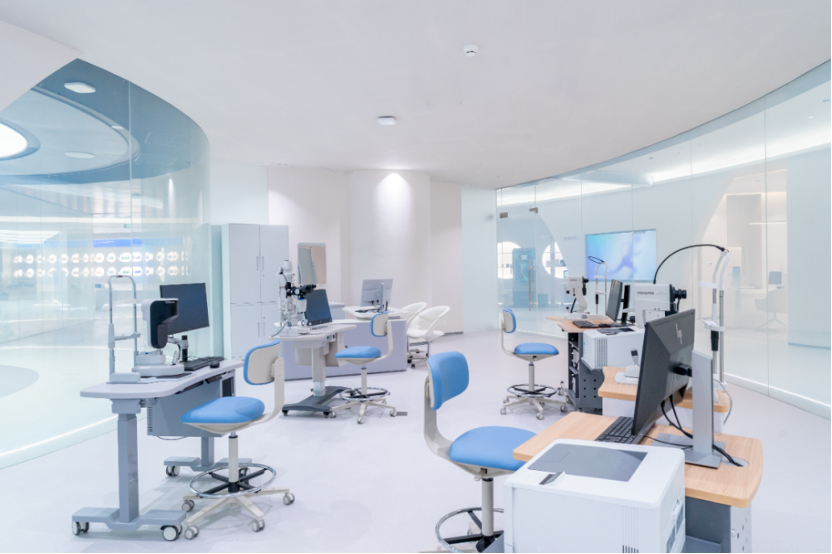
The Eye Health Center at BGI Future Intelligent Health Center.
What Can the Report Tell You?
Eye age. The report begins with an overall reference indicator: the biological age of your eyes, calculated from multiple physiological measurements. It offers a snapshot of ocular condition while also reflecting the cumulative effects of daily routines, screen habits, and general physical state - a timely prompt to adjust lifestyle where needed.
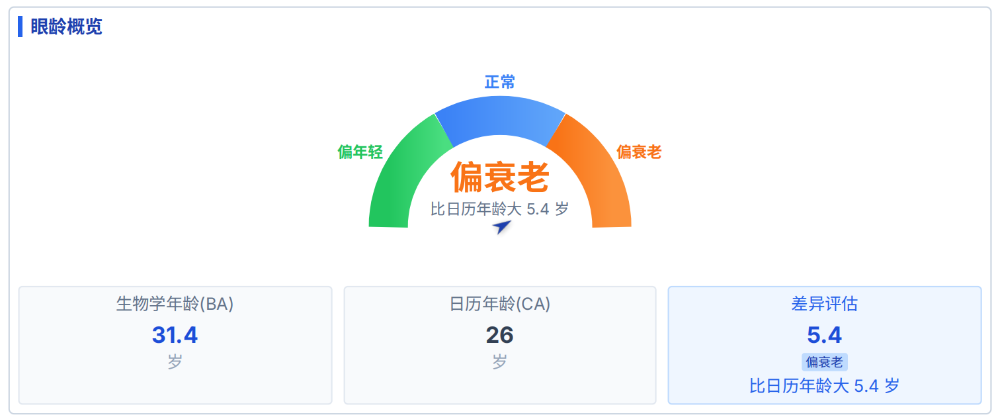
Eye age indicator.
Cup-to-disc ratio. Among core ocular indicators, the report highlights the cup-to-disc ratio, a key marker for glaucoma. Often called the "silent thief of sight," glaucoma is the world's leading cause of irreversible blindness. It typically causes no pain or discomfort in its early stages, and by the time visual field loss appears, the damage is usually permanent. By precisely quantifying the cup-to-disc ratio, the platform can capture hidden early warning signs and support timely prevention and treatment.
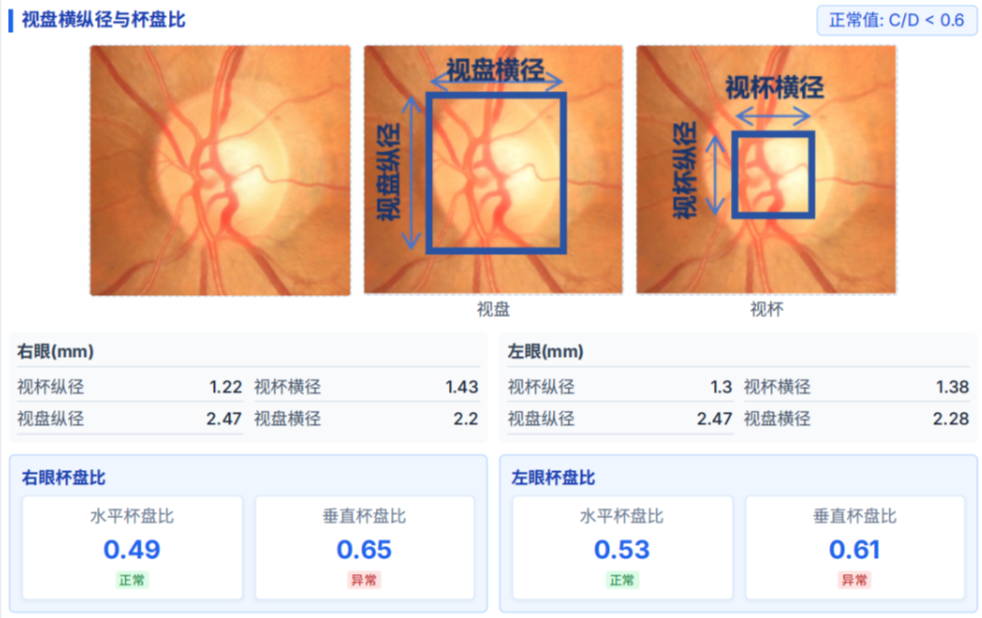
Cup-to-disc ratio indicator.
Multi-dimensional risk assessment. The report evaluates dozens of health dimensions, assigning scores and risk grades that intuitively indicate the likelihood of related conditions, including:
- Common eye diseases: Comprehensive screening for high-incidence conditions such as cataract, glaucoma, macular degeneration, and retinal vein occlusion, capturing early signs of pathology.
- Cardiovascular disease: The retinal vessels serve as a natural barometer of cardiovascular and cerebrovascular health, providing early warning of risks such as coronary heart disease and atherosclerosis.
- Endocrine and chronic metabolic conditions: Subtle changes in the fundus microvasculature can signal risks of diabetes, hyperlipidemia, and other chronic diseases.
- Neurological and mental health: Supporting the assessment of cognitive function and neurological status.
The report also delivers personalized prevention recommendations tailored to each risk item, covering practical guidance such as UV protection, healthy screen habits, dietary suggestions, exercise plans, follow-up intervals, and chronic disease management essentials. Individuals identified as medium-to-high risk receive proactive follow-up reminders and referrals to specialist care.
Bringing Accessible Screening to Daily Scenarios
The platform has now been deployed at the BGI Group Global Headquarters’ BGI Future Intelligent Health Center. With the aforementioned features, this platform is well suited not only to corporate health programs but also to primary healthcare, public health screening, hospitals, physical examination centers, schools, and community health centers.
It should be noted that eye-based screening is positioned as a health risk alert and auxiliary screening tool - it does not replace professional medical diagnosis. But this approach of "reading the whole body through the eye" points toward a direction in preventive medicine which is worth embracing.
The eyes never lie about the state of our health. Our task is to learn to read their gentle reminders - and through early screening, early diagnosis, and early intervention, safeguard our long-term wellbeing.