



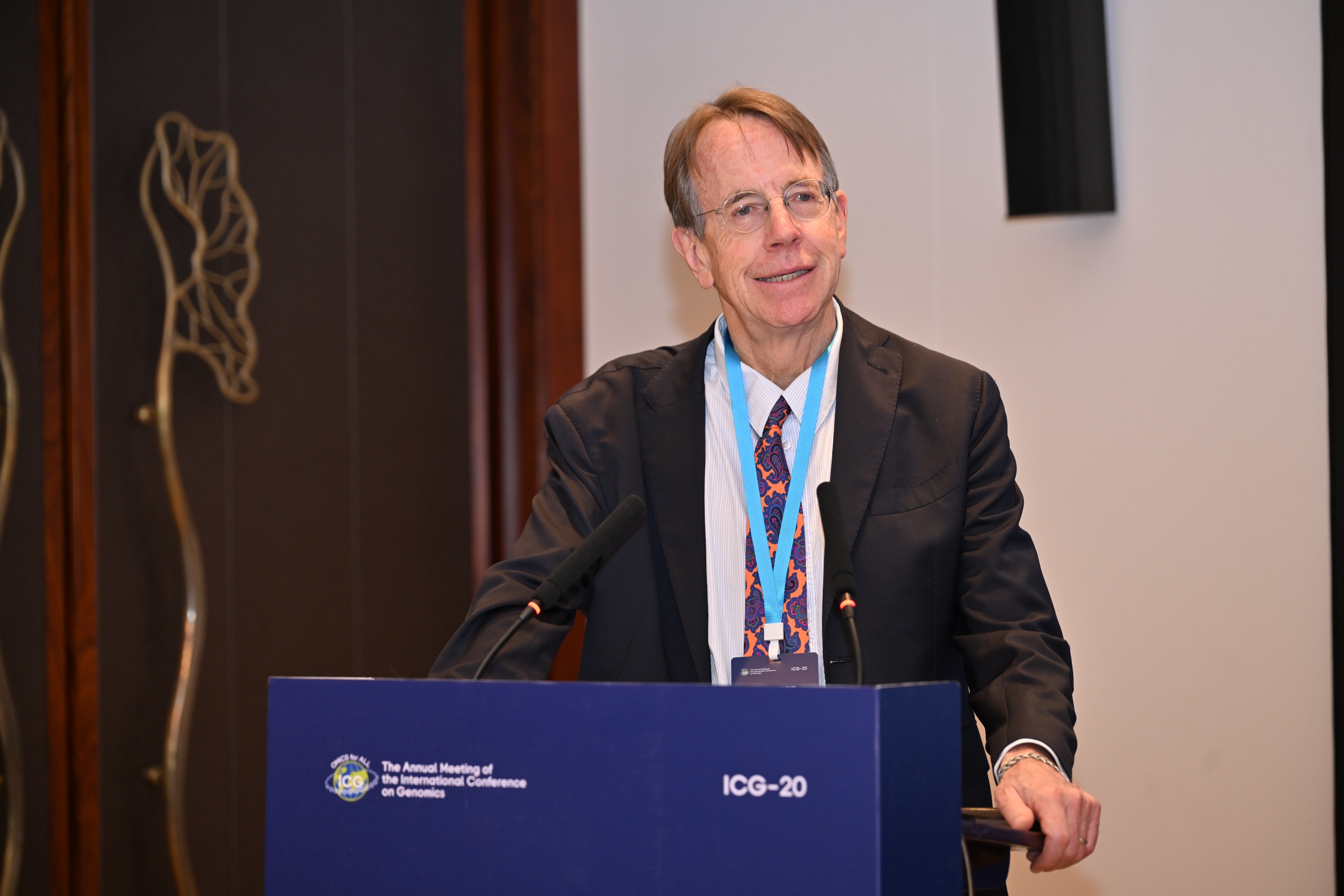
 Sir Rory Collins delivered a speech at the ICG-20 conference in Hangzhou. (Credit: ICG-20 Committee)
“Science moves forward through collaboration, not just in the academic sector in different universities, but collaboration in and with industry across different parts of the world.”
This was a clear message from Sir Rory Collins, Principal Investigator and Chief Executive of UK Biobank, speaking during his attendance at the 20th Annual Meeting of the International Conference on Genomics (ICG-20) held recently in Hangzhou.
More than 100 scientists and guests from 19 countries and regions attended ICG-20, highlighting its continued importance in connecting international scientific efforts and promoting progress in life sciences.
The UK Biobank was established in 2003 by the UK Government, the Medical Research Council and the Wellcome medical charity with the aim of tracking the long-term health of people as they age. 500,000 people between the ages of 40 and 69 agreed to make their health-related data, lifestyle and environmental information available for research. This enabled the UK Biobank to begin to undertake the decades-long study of people’s health as they age; a study that continues to provide information on the participants.
Sir Rory notes that the founders of the UK Biobank “were very clear that they wanted the data to be used by as many different scientists from across the world in order to generate as much knowledge as possible.”
Scientists who fulfil the UK Biobank’s strict access and data compliance criteria are given access to the UK Biobank Research Analysis Platform, a secure cloud-based system that ensures no raw data can be downloaded or transferred outside of its environment, for research that may lead to the identification, treatment and prevention of diseases.
BGI Group is one of over 22,000 registered researchers from more than 60 countries who have applied for and been granted access to the UK Biobank. The BGI current research is focused on developing a new algorithm related to biological aging and disease risk prediction utilizing multi-omics data. According to the researchers, it is hoped that the information can “guide resource allocation and targeted interventions, optimizing healthcare delivery.”
Many countries from the U.S. to Japan and from China to Europe operate biobanks or gene banks to store anonymized genetic data for international scientific research. The China National GeneBank (CNGB) in Shenzhen, for example, is a world-leading integrated gene bank, supporting the storage of biological resources, as well as the reading, synthetization and application of genetic information, and is accessible for scientific research.
Sir Rory points both to the UK Biobank and the CNGB to explain that the “coming together of lots and lots of information on very large numbers of people is helping us to understand why it is one person develops a particular disease and another one doesn’t. And that will help us understand how better to prevent and treat those diseases.”
He notes that BGI Group’s development of specialized cutting-edge technology has allowed “the benefits of genetic data to be democratized, to be much more widely available.”
By making data widely available, Sir Rory believes that the UK Biobank is “demonstrating what you can learn from making data available, but also demonstrating what is lost if you don’t make data available.”
He concludes, “I think that the UK Biobank demonstrates and encourages others to share their data, encourages governments to facilitate access to data, so that all the people around the world benefit from better knowledge about how to prevent and treat diseases.”