



Bryophytes—comprising liverworts, mosses, and hornworts—were among the earliest plant groups to adapt to terrestrial environments during the process of land colonization. Marchantia polymorpha, a representative liverwort, serves as an ideal model for exploring the origin and evolution of sexual reproduction in plants. Although its reproductive structures are relatively simple, they fully encompass core reproductive processes such as spermatogenesis, fertilization, and sporophyte development. However, due to the high diversity of cell types and a lack of high-resolution expression profile data, the molecular mechanisms governing cell differentiation and functional regulation during these processes have yet to be systematically elucidated.
On January 2, 2026, a team led by BGI-Research, the State Key Laboratory of Genome and Multi-omics Technologies, and Shenzhen Fairy Lake Botanical Garden, and supported by the 10 KP project and the Scientific Foundation of the Urban Management Bureau of Shenzhen, published a cover story titled "Transcriptomic landscape of Marchantia polymorpha sexual organs at single-nucleus resolution" in the Journal of Genetics and Genomics. Utilizing single-nucleus RNA sequencing (snRNA-seq), the study constructs a high-resolution cellular map of Marchantia polymorpha's sexual organs. It systematically dissects the cellular composition and molecular regulatory foundations of key biological processes, including spermatogenesis, sporophyte formation, and sporopollenin synthesis.
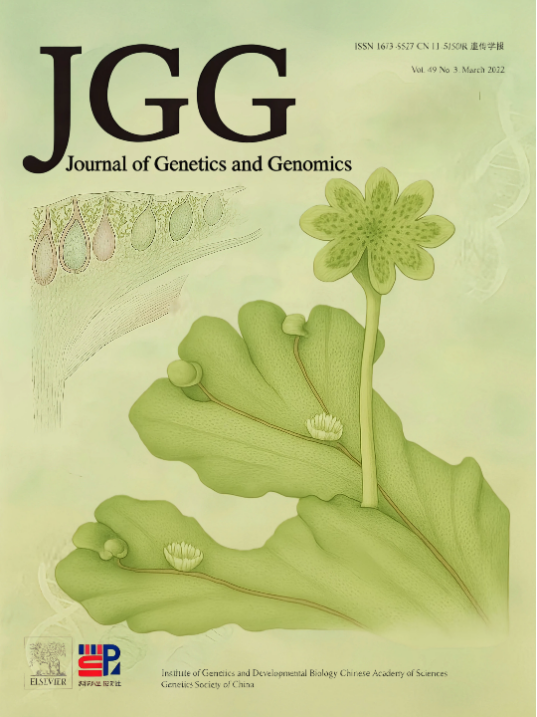
Cover of Journal of Genetics and Genomics featuring “Transcriptomic landscape of Marchantia polymorpha sexual organs at single-nucleus resolution”.
This study presents the first systematic single-cell resolution transcriptomic atlas of Marchantia polymorpha's sexual organs. Utilizing their single-nucleus RNA sequencing (snRNA-seq) platform, the research team successfully acquired over 30,000 high-quality single-nucleus transcriptomes. From these, they identified 18 and 26 distinct cell clusters in male and female samples, respectively. This high-precision analysis allowed for a detailed elucidation of the cellular composition and molecular characteristics of key structures, including antheridiophores (male receptacles), archegoniophores (female receptacles), and sporophytes.

Construction of a single-nucleus transcriptomic atlas of sexual organs in M. polymorpha using snRNA-seq.
Based on the antheridiophore single-cell transcriptome data, the study successfully reconstructed a continuous developmental trajectory from early antheridial cells to mature sperm. This trajectory clearly delineated the progressive transitions in cell states during spermatogenesis and, through pseudotime analysis, predicted key regulatory factors at developmental branch points. Furthermore, researchers identified critical gene modules associated with cell cycle regulation, chromatin remodeling, and calcium signaling, thereby providing crucial insights into the developmental mechanisms of male germ cells in bryophytes.
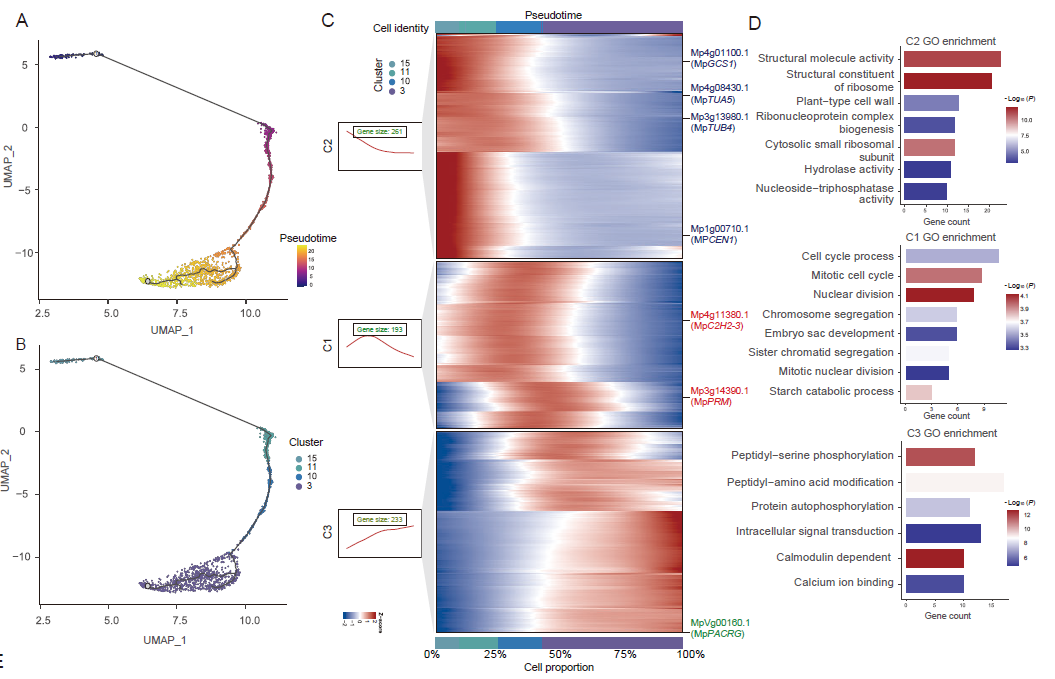
Pseudotime analysis of cell differentiation from early-stage antheridium to mature sperm in M. polymorpha.
From the archegoniophore single-cell transcriptome data, the study further elucidated the functional differentiation of various cell types within the diploid sporophyte, including foot cells, capsule wall cells, and elaters. This analysis revealed their specific roles in key biological processes such as sporopollenin synthesis, cell wall biogenesis, and spore protection. Ultimately, this work provides crucial foundational data and novel insights for a deeper understanding of the unique mechanisms of sporophyte development in bryophytes.
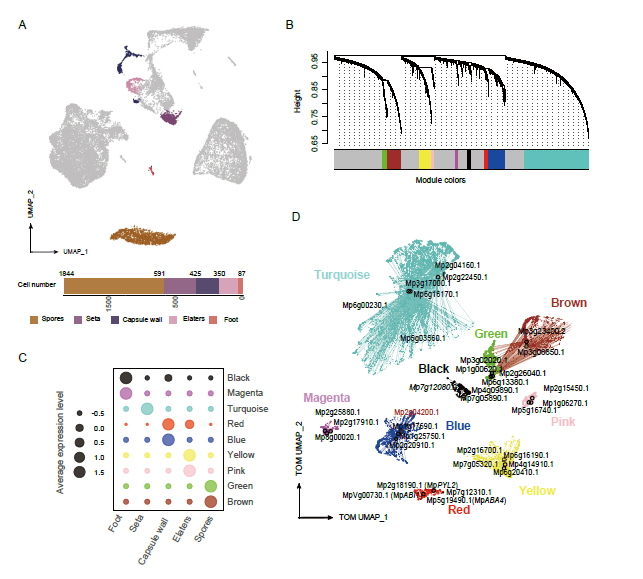
Intracellular co-expression regulatory networks specific to sporophyte cell types.
These cross-species comparisons highlighted notable functional parallels between Marchantia's scapsule wall cells and tapetum cells of angiosperms. Study shows that foot cells serve as a central hub mediating communication between the maternal gametophyte and the developing sporophyte, performing critical functions in both nutrient transport and developmental orchestration.
Digging deeper, 20 cross-species conserved marker genes, including sporopollenin biosynthesis genes such as ACOS5 and TKPR1 conserved between Marchantia polymorpha and Arabidopsis thaliana, pointing to an ancient evolutionary lineage for this pathway across land plants. Intriguingly, the Marchantia sporophyte capsule wall demonstrates a multifunctional nature, whereas Arabidopsis' tapetum is highly specialized. This contrast unveils a broader evolutionary trend: a shift in plant cell function from versatility to focused specialization.
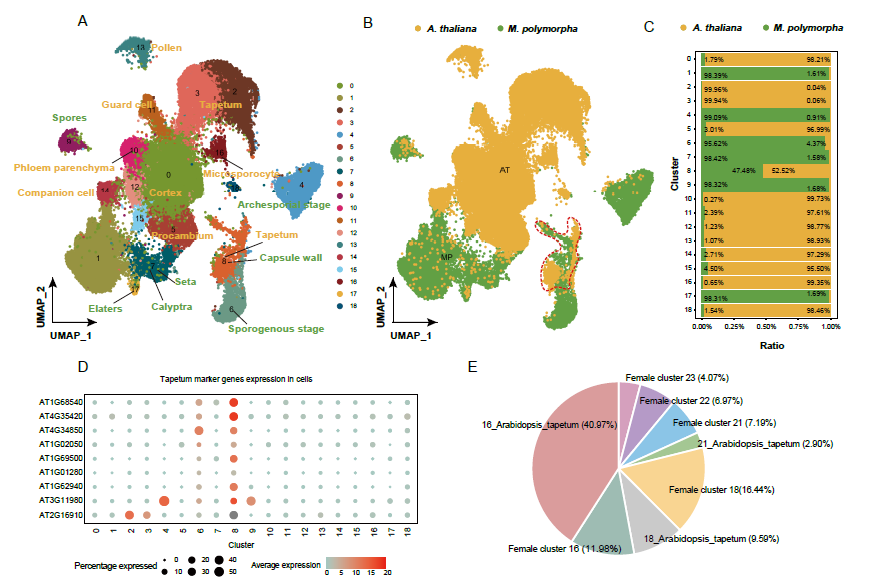
Cross-species analysis of M. polymorpha and A. thaliana.
Ultimately, this research provides crucial references and rich data resources, significantly advancing the understanding of the cellular basis and evolutionary mechanisms of sexual reproduction in early land plants. While Marchantia and cultivated crops exhibit significant morphological divergence, this study reveals a remarkable conservation of core biological processes—including spermatogenesis, sporopollenin synthesis, and spore formation—across diverse land plants.
The key gene regulatory modules identified and the advanced single-cell technology platform established in this work, therefore, present valuable insights directly applicable to molecular breeding strategies for crops. These outcomes facilitate the targeted discovery of functional genes governing anther development, pollen stress resistance, and reproductive interactions.
Critically, they provide evolutionarily derived genetic resources and a robust technical framework, paving the way for novel breeding strategies aimed at developing stress-resistant and high-yielding crops.
This study can be accessed here: https://doi.org/10.1016/j.jgg.2025.11.002