



Ten researchers from BGI have been named to the 2026 World’s Top 2% Scientists annual list, highlighting the organization’s sustained research output and academic influence in the life sciences.
Ten BGI researchers named to 2026 World’s Top 2% Scientists List.
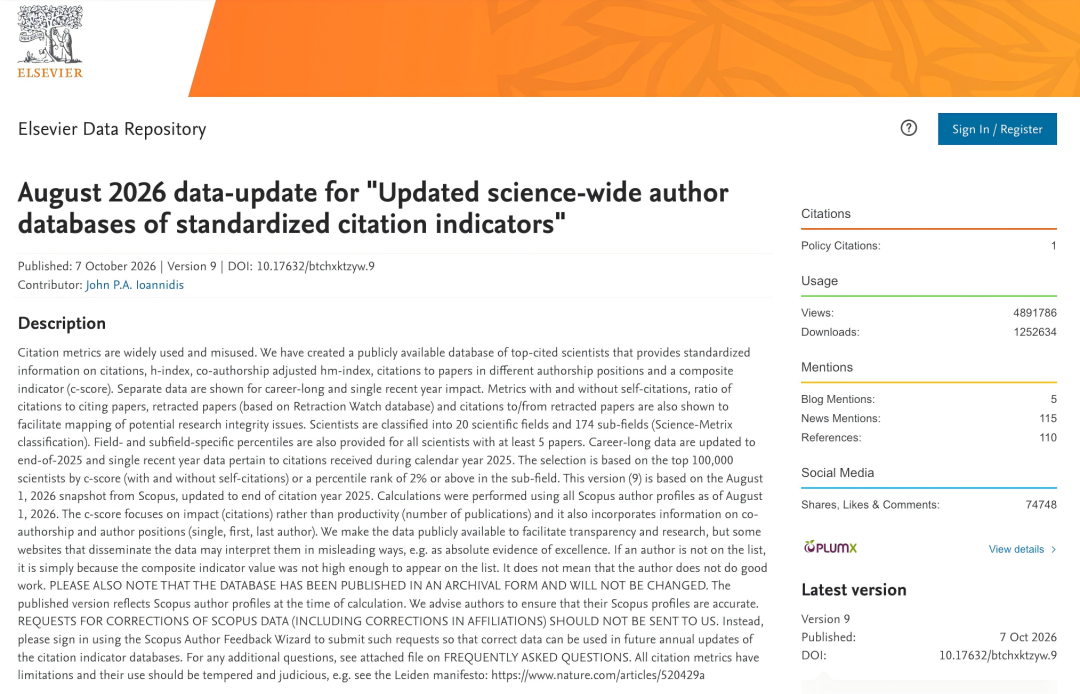
The World’s Top 2% Scientists database, developed by Stanford University and Elsevier, is based on Scopus citation data and provides standardized citation indicators for scientists worldwide. The list takes into account metrics including total citations, h-index, co-authorship-adjusted hm-index, citations to papers in different authorship positions, and a composite citation indicator. Scientists are classified across 20 scientific fields and 174 subfields. The 2026 update includes data assessing researchers’ citation impact during 2025.
Among the BGI researchers included in this year’s annual scientific impact list, several have appeared on the list for multiple consecutive years. Dr. Huanming Yang, Co-founder of BGI Group and a member of the Chinese Academy of Sciences, has been included for five consecutive years. Dr. Xun Xu, Chief Researcher of BGI Group, has been listed for seven consecutive years since 2020.
Several BGI researchers were included for the first time this year, including Dr. Longqi Liu, Executive Director of BGI-Research; Dr. Sunil Kumar Sahu, Associate Researcher at BGI-Research; and Dr. Chi Zhang, Associate Researcher at BGI Genomics. Other BGI researchers recognized this year include Dr. Junhua Li and Dr. Zhuye Jie of BGI-Research, as well as Dr. Liang Xiao, Chief Scientist of BGI Nutri.
Beyond this year’s World’s Top 2% Scientists list, BGI researchers have been included in Clarivate’s Highly Cited Researchers list for 12 consecutive years and in Elsevier’s Highly Cited Chinese Researchers list for 12 consecutive years. In the 2026 Nature Index annual tables, BGI Group ranked first globally among corporate institutions in biological sciences and has led corporate institutions in biological sciences in the Asia-Pacific region for 11 consecutive years.
These recognitions reflect BGI’s long-term investment in scientific research and technological innovation. As of October 10, 2026, BGI had published 6,262 scientific papers, including 964 papers in CNNS journals (the leading academic journals Cell, Nature, New England Journal of Medicine, Science, and their related publications, if any) of which 201 were published in flagship journals.
In recent years, BGI research teams have continued to advance multi-omics technologies, including genomics, cellomics and spatiotemporal omics. Leveraging these platforms, they have pursued frontier research in fields such as brain science, embryonic development, regenerative medicine and life in extreme environments.
Looking ahead, BGI will continue to leverage its integrated industry-academia-research platform, independently developed core technologies and scientific infrastructure to deepen global research collaboration, promote the translation and application of scientific advances, and further its mission of using genomics to benefit humanity.