



On November 3, researchers at Peking Union Medical College Hospital, BGI-Research, and collaborating institutions report in Nature Medicine that baseline microbiomes dictate individual outcomes in menopausal hormone therapy. The six-month longitudinal study tracked four distinct microbial niches in the same women, directly linking baseline vaginal and gut microbiome to local ecological remodeling, hormone dynamics, and symptom relief speed.
The study “Heterogeneity of Microbiome Responses to Menopausal Hormone Therapy among Perimenopausal Women” was published in Nature Medicine.
During perimenopause, sharp estrogen fluctuations frequently trigger hot flushes, sleep disturbances, mood changes, and urogenital discomfort. Standard hormone therapy eases these complaints for many women, yet treatment responses vary widely from person to person. This clinical puzzle points to the body’s microecology: estrogens and mucosal microenvironments engage in a dynamic crosstalk, with systemic hormones shaping local bacterial communities across the body. The question then arises: how do these microbes shift in response to treatment, and to what extent do they drive or limit a woman's clinical relief? To uncover this under routine clinical care, the team tracked 356 symptomatic women across 14 clinical institutes in China during a 24-week oral hormone regimen (estradiol/dydrogesterone). Researchers analyzed 4,025 samples collected from four body sites (gut, tongue, reproductive tract, and urine) alongside detailed symptom questionnaires at baseline and weeks 4, 12, and 24, and blood hormone and metabolic profiles at baseline and week 24, offering a clear, high-resolution roadmap of why individual responses to hormone therapy differ.
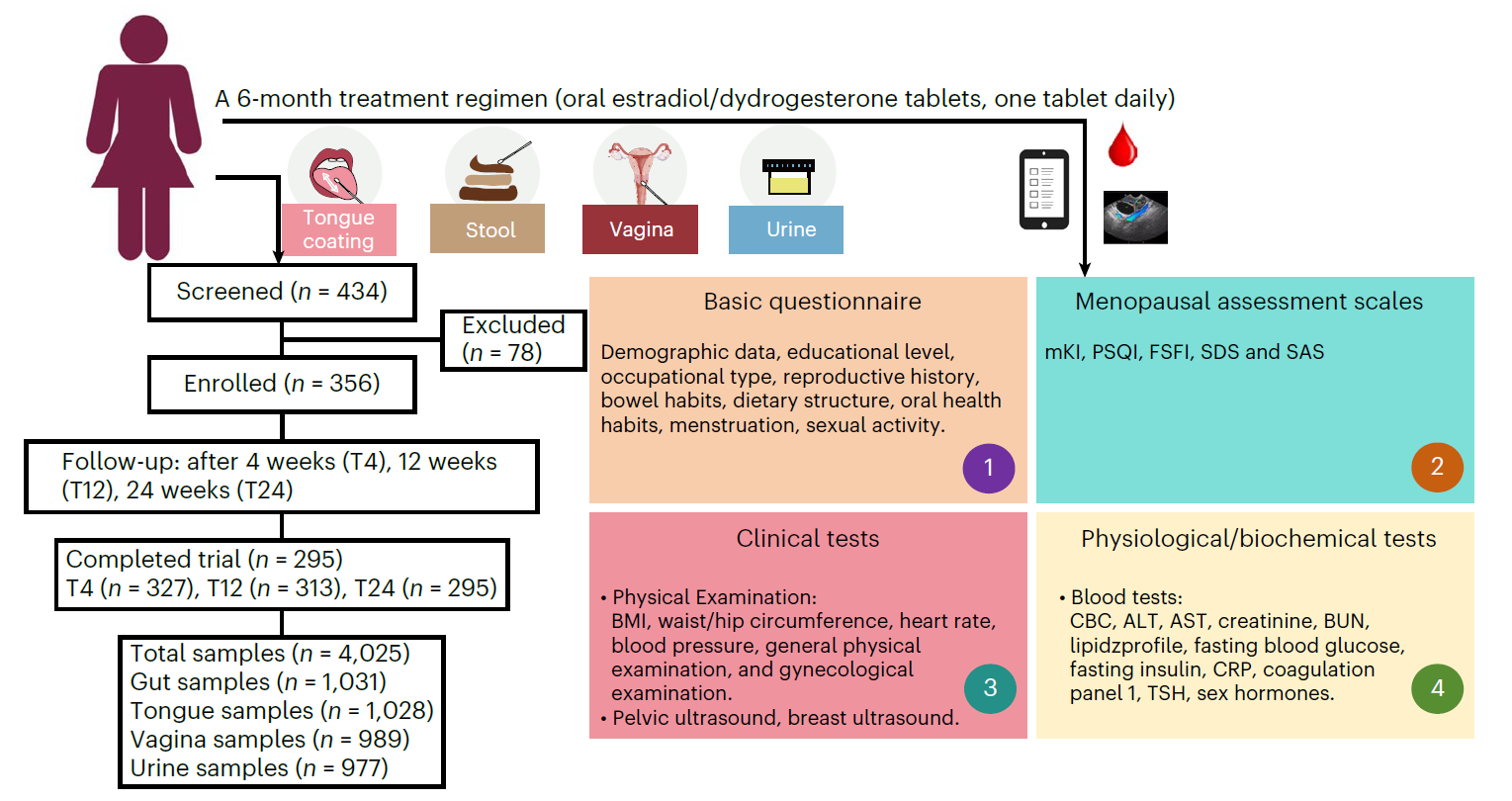
Longitudinal sampling of four microbial habitats during six months of standard hormone therapy links baseline vaginal and gut microbiome with subsequent clinical and hormonal responses, providing a framework for studying how menopausal symptom relief varies among women.
While MHT broadly elevated overall quality of life and eased classic menopausal complaints, therapeutic gains were distinctly uneven across symptom domains. Sexual health, evaluated via the Female Sexual Function Index (FSFI), showed the widest individual variation and the most delayed recovery among participants. Intriguingly, this clinical pattern mirrored a sharp divide in the body’s microecology: while the vaginal and urinary niches proved exquisitely sensitive to systemic hormone replenishment, undergoing rapid, profound structural remodeling, the oral microbiome changed moderately, and the gut microbiome remained remarkably stable and ecologically resilient throughout treatment.
Importantly, baseline ecology dictated outcomes: women with vaginal communities already dominated by L. crispatus maintained superior initial sexual function, and longitudinal enrichment of this species statistically mediated treatment-induced sexual recovery, demonstrating that L. crispatus is a key for mucosal and functional rejuvenation. Women whose baseline gut communities were enriched with Phocaeicola vulgatus achieved both six-month hormone targets and rapid four-week symptom relief far more than those dominated by Prevotella copri. With overall gut species composition remaining notably resilient during therapy, this divergence points toward functional differences in the specialized bacterial genes that reactivate estrogens via the liver-to-gut enterohepatic recycling loop, thereby regulating systemic hormone bioavailability. Further direct experimental proof remains needed to confirm enzyme activity and hormone absorption.
In clinic, the speed of therapeutic relief is paramount. Capitalizing on these multi-system insights, the team developed a machine-learning model that combining baseline gut microbial profiles with routine clinical metrics, including mood, sleep scores, and symptom scores. Evaluated in 70 participants, this multi-modal approach significantly outperformed standard clinical assessments alone in forecasting four-week rapid symptom remission, offering a promising roadmap toward precision medicine for menopausal care.
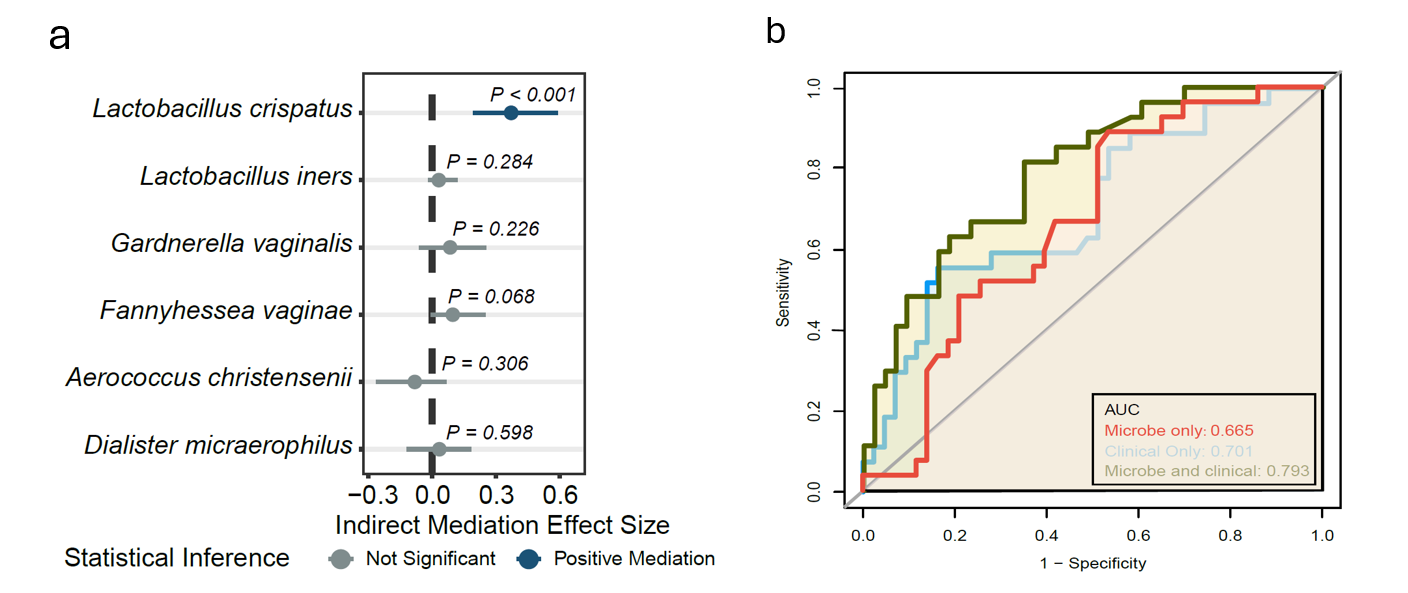
Analyses of vaginal microbial mediation of sexual function and gut-clinical forecasting of early MHT response, offering leads for research on more individualized menopause care.
Extending this longitudinal multi-site framework to independent cohorts, controlled trials, direct assays of gut microbial enzyme activity and hormone metabolism, and targeted studies of vaginal Lactobacillus species could clarify how microbes interact with hormone therapy and inform future research on individualized menopause care.
The study received ethical approval, and all participants gave written informed consent.
This research can be accessed at: https://www.nature.com/articles/s41591-026-04737-4.