



Two China national standards proposed and drafted under the leadership of BGI-Research have been officially released: GB/T 46927-2025, "Spatio-temporal omics—Specification for dataset format", and GB/T 46935-2025, "Single-cell sequencing—Dataset of single cell transcriptome". These standards will come into effect on July 1, 2026.
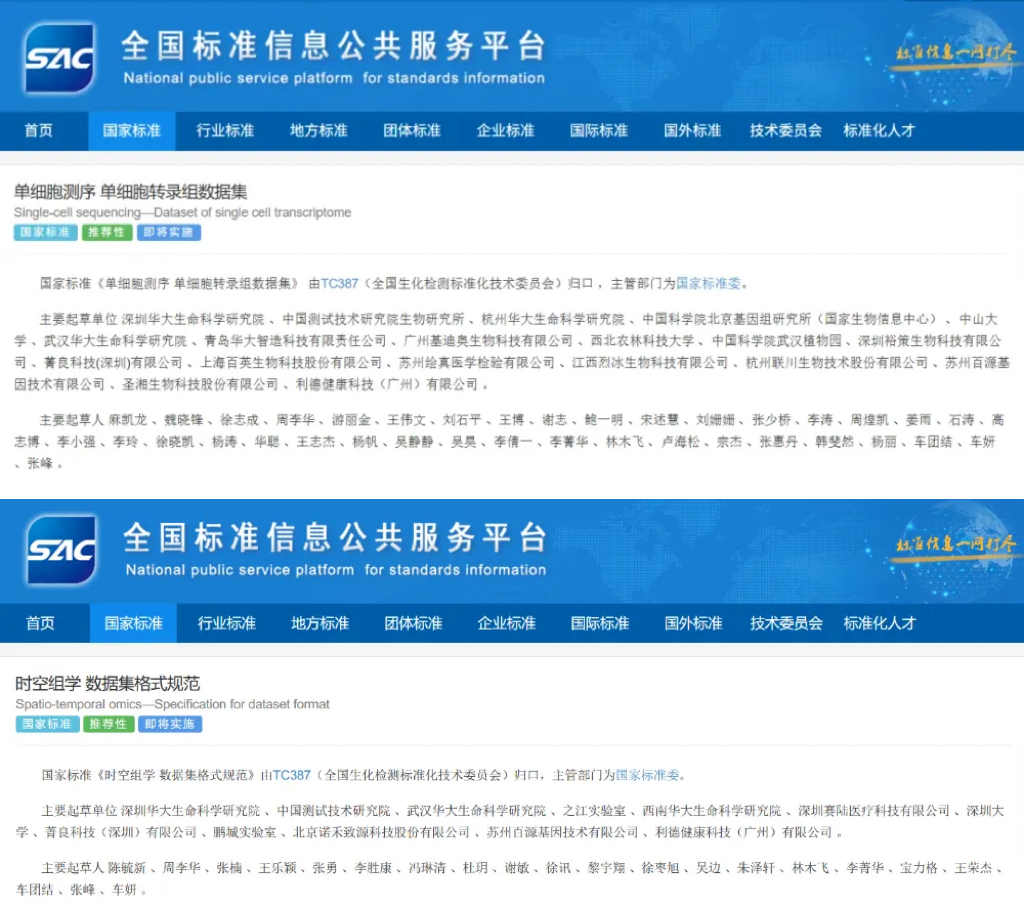 Two China national standards proposed and drafted under the leadership of BGI-Research have been officially released.
The standards represent a collaborative effort between BGI-Research and dozens of partner organizations. Their release represents an important step in establishing a standardized multi-dimensional data framework for spatio-temporal omics and single-cell omics in China. By addressing the need for consistent, high-quality data, these standards are expected to provide valuable support for applications such as artificial intelligence model development, disease mechanism research, and other areas of life sciences innovation.
The GB/T 46927-2025 "Spatio-temporal omics—Specification for dataset format" standard defines the storage and format requirements for spatio-temporal omics datasets, including metadata, data files, and storage directory structures. It provides detailed guidelines to improve the consistency and accessibility of spatio-temporal omics data for research and application.
And the GB/T 46935-2025, "Single-cell sequencing—Dataset of single cell transcriptome" standard specifies the scope, data format requirements, metadata definitions, archiving protocols, and security measures for single-cell transcriptome datasets. It is designed to facilitate the storage, management, and sharing of single-cell sequencing data.
Both standards were submitted by the National Biochemical Testing Standardization Technical Committee (SAC/TC 387) and are overseen by the National Standardization Administration of China.
Life sciences research generates highly complex datasets, often characterized by their large scale, high dimensionality, and interdisciplinary nature. Without a standardized approach, the lack of compatibility between datasets can hinder data sharing and limit their value for research and practical applications.
For example, single-cell sequencing produces massive, sparse, and heterogeneous datasets aimed at uncovering cellular heterogeneity, while spatio-temporal omics provides deeper insights into life processes by analyzing data across time and space. These cutting-edge efforts produce enormous, intricate datasets that require consistent formatting and organization to realize their full potential.
The two newly released standards aim to address these challenges by providing a "common language" for life sciences data. They establish clear guidelines for dataset collection, storage, and sharing, ensuring consistency and quality across the research and application pipeline.
The successful development of these standards reflects BGI’s long-standing commitment to advancing life sciences research. Over the years, BGI and its partners have contributed to key breakthroughs in genomic technologies, many of which have been published in leading journals. These achievements have supported progress in areas ranging from disease research to precision medicine.
In August 2025, the State Key Laboratory of Genome and Multi-omics Technologies, led by BGI-Research, published the Stereo-seq V2 technology in Cell. This technology offers new ways to analyze archived clinical samples, enabling more precise understanding of cellular and microbial interactions.
In the same month, the lab introduced the Stereo-cell technology in Science, achieving breakthroughs in multi-modal integration and high-throughput compatibility, which have the potential to drive advances in cell pathology, immunity, and evolutionary research.
In January 2026, the lab and its partners published the Chinese Immune Multi-Omics Atlas (CIMA) in Science. The study introduces CIMA-CLM, a cell language model that integrates chromatin sequence features and single-cell gene expression to predict chromatin accessibility and assess the functional impact of noncoding variants.
BGI-Research remains committed to supporting innovation in life sciences through collaboration and the development of advanced technologies and data frameworks. Moving forward, the organization aims to continue contributing to the development of a robust ecosystem that bridges scientific discovery, technological advancement, and industry application.
With the implementation of these standards, BGI hopes to support the broader research community in unlocking the potential of life sciences data and applying it to benefit public health.
The standards can be accessed here:
GB/T 46927-2025, "Spatio-temporal omics—Specification for dataset format”
https://std.samr.gov.cn/gb/search/gbDetailed?id=14CA9F8A7B2A5ACAE06397BE0A0A9979
GB/T 46935-2025, "Single-cell sequencing—Dataset of single cell transcriptome”
https://std.samr.gov.cn/gb/search/gbDetailed?id=473EBB99D65A455EE06397BE0A0ABB9A