



Recently, investigators at Shanxi Medical University and State Key Laboratory of Genome and Multi-omics Technologies at BGI-Research reported in the Journal of Allergy and Clinical Immunology a single-cell multi-omics atlas of the human nasal mucosa that compares allergic rhinitis (AR) with non-allergic rhinitis (NAR). By profiling over one million individual cells from 39 patients, the authors observed disrupted molecular communication between the nasal epithelial lining and its supporting stromal cells in allergic rhinitis compared with non-allergic rhinitis. They suggest that allergic rhinitis may involve a broader tissue-level disruption beyond immune overreaction alone.
The study “Decoding the epithelial-stromal interactome in allergic rhinitis through single-cell multi-omics integration” was published in the Journal of Allergy and Clinical Immunology.
Allergic rhinitis is a chronic, IgE-mediated inflammation affecting more than 500 million people worldwide. Despite available treatments, 30 to 40 percent of patients respond inadequately to existing medications, and allergen immunotherapy is limited by poor adherence. While immune cells have long been the focus of allergy research, increasing evidence points to structural cells, including epithelial cells that line the surface and stromal cells that provide support beneath, as potentially important contributors to disease pathology. This study sought to determine, at single-cell resolution, how these non-immune tissue populations differ between the two conditions.
The research team performed single-cell RNA sequencing on nasal mucosal tissue from all 39 patients and single-cell ATAC sequencing on a subset of 24 patients, which reveals which regulatory regions of the genome are open and available to control gene activity, . Sequencing was carried out on DNBSEQ platforms. After quality filtering, the atlas comprised 588,526 transcriptomic profiles resolved into 65 cell subtypes across epithelial, immune, and stromal compartments, alongside 435,620 epigenomic profiles grouped into 14 chromatin-accessibility subsets. The most pronounced differences between groups occurred not in immune populations but in epithelial and stromal cells: basal cells and secretory cells were significantly reduced in the AR group, while fibroblasts were increased.
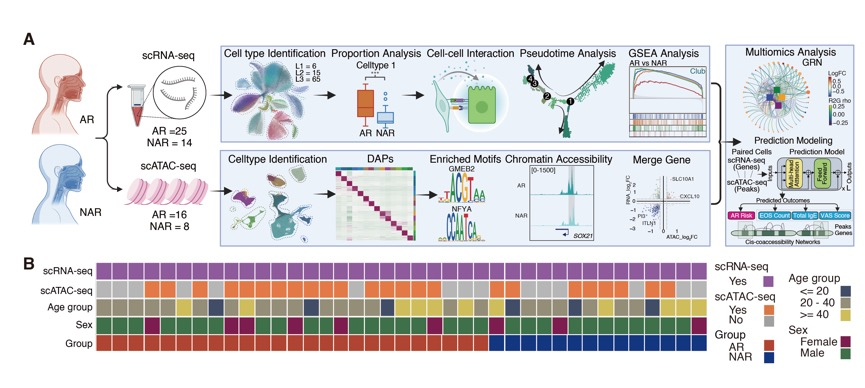
AR/NAR nasal-tissue atlas.
In the AR nasal mucosa, club cells are diminished and display impaired differentiation, releasing more pro-inflammatory and pro-remodelling factors, which correlate with symptom severity. Concurrently, two stromal subsets—Activated Pericytes and Fibro_CXCL2—though reduced in abundance, robustly express pro-inflammatory and remodelling genes, including POSTN and FADS1, potentially fuelling epithelial damage and tissue remodelling. Collectively, these cellular aberrations establish a pro-inflammatory microenvironment that propels disease progression.
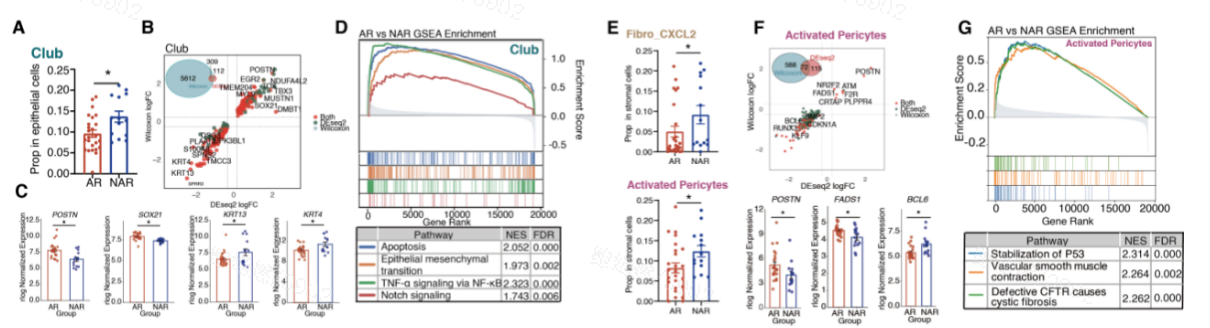
Epithelial-cell and stromal-cell states shift in AR and NAR groups.
Intercellular communication is critical for nasal homeostasis. Through cell–cell interaction analysis, the team observed that crosstalk between epithelial and stromal cells in the nasal mucosa of AR patients is aberrantly activated, engaging inflammatory and tissue-remodelling pathways that perpetuate a "damage–inflammation–further damage" vicious cycle.
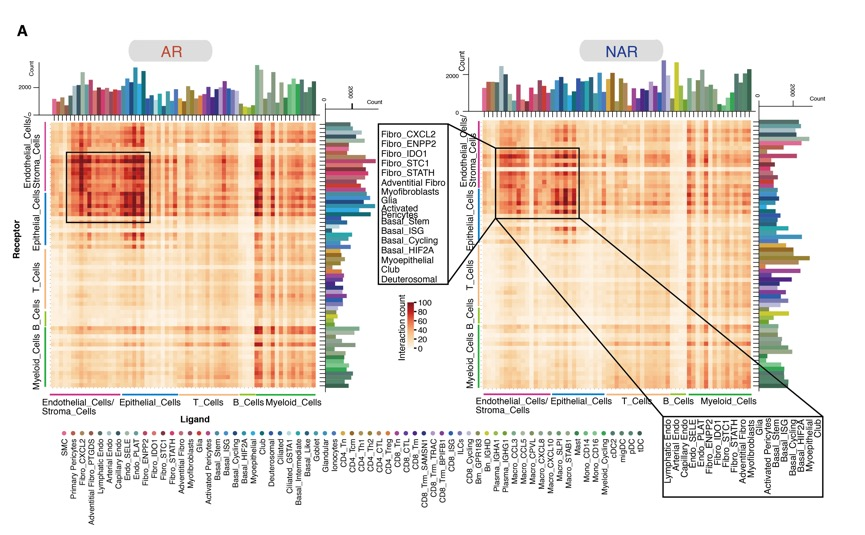
Epithelial-stromal signalling changes in AR and NAR groups.
To convert these signatures into predictive insights, the team developed scMARIA (Single-cell Multi-omics for Allergic Rhinitis Integrative Analysis), a deep-learning framework that pairs gene-expression and chromatin-accessibility measurements from separate cells to learn joint molecular portraits of disease. Evaluated on a held-out test set of five donors, scMARIA successfully classified AR status in fibroblasts, basal cells, and secretory cells, and captured significant correlations with VAS (Visual Analogue Scale) scores. scMARIA also enables the identification of disease-specific putative regulatory peak-gene linkages across distinct cell subtypes. For instance, SOCS3 and TNFAIP3 exhibited markedly distinct epigenetic patterns between AR and NAR groups in fibroblasts and secretory cells.
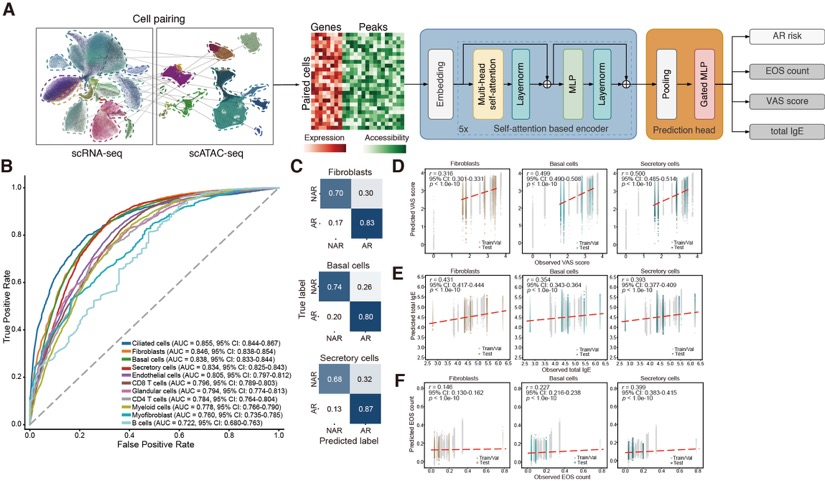
scMARIA predicts AR status and clinical measures.
By integrating transcriptomic and epigenomic data from over one million nasal mucosal cells, this study reveals that the nasal mucosa of AR patients is characterized by aberrant epithelial differentiation, stromal inflammatory activation, and augmented epithelial–stromal crosstalk. Collectively, these findings position the epithelial–stromal interface as a critical axis in the pathogenesis of AR, and may help the development of new therapeutics that restore epithelial–stromal homeostasis, with the potential to halt or even reverse the natural history of allergic rhinitis.
This study received ethics approval and all participants provided informed consent.
This research is available at: https://doi.org/10.1016/j.jaci.2026.06.020