



Recently, researchers at BGI-Research, Shanghai Jiao Tong University, the Institute of Deep-Sea Science and Engineering (Chinese Academy of Sciences) and collaborating institutions, published the second stage results of the Mariana Trench Environment and Ecology Research (MEER) Project in Cell Host & Microbe. This exciting set of findings, reported in three research articles and an opinion piece, includes a comprehensive global genetic and structural resource for deep-sea microbes, and proteome-level evidence of the functions hadal seawater communities express.
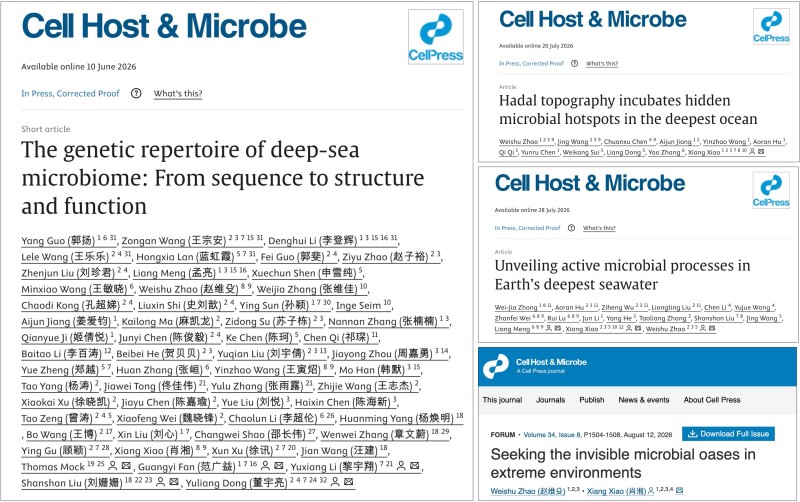 The second-stage results of the Mariana Trench Environment and Ecology Research (MEER) Project were reported in three research articles and an opinion piece in Cell Host & Microbe.
Through an innovative, integrative multidimensional approach that covers the "high-pressure stimulation" hypothesis, activity-informed protein interaction networks, global deep-sea genomic and structural proteomic resource mapping, and terrain-modulated carbon cycling dynamics, the research team has systematically discovered previously unrecognized microbial "oases" in the hadal zone. This fascinating work successfully pushes hadal microbiology research forward, shifting the focus from descriptive ecological characterization to mechanistic insight and bioprospecting-oriented discovery, and it also consolidates the fruitful, collaborative international progress in deep-sea life sciences driven by contributions from global research communities.
That inventory began with 2,138 metagenomes, spanning hydrothermal vents, methane seeps, hadal trenches, and other habitats below 1,000 meters, assembled into the Deep-Sea microbial Gene Catalog (DSGC), a collection of 502 million nonredundant genes. When clustered with the Global Ocean Gene Catalog, the DSGC expanded that catalog’s genetic diversity by over 50%.
To move beyond sequence alone, the team used computational protein-structure prediction to build the Deep-Sea Fold Catalog (DSFC), containing 2.4 million predicted protein structures, of which approximately 1.1 million were high-confidence. Among these, 392 protein domains had no detected structural match in the AlphaFold Database, pointing to untapped structural diversity in the deep-sea proteome. Evolutionary analyses indicated that deep-sea microbes carry elevated frequencies of rapidly evolving genes, particularly those involved in DNA maintenance, the machinery that copies and repairs genetic material.
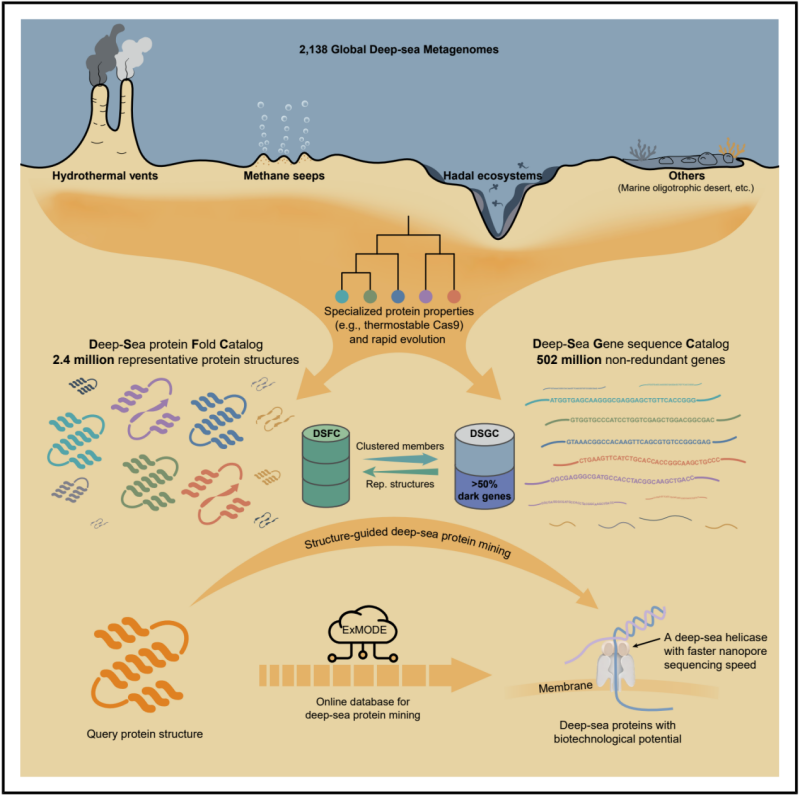 From 2,138 global deep-sea metagenomes to the 502-million-gene DSGC and the 2.4-million-structure DSFC, the resource pipeline ends in structure-guided identification of candidate proteins with potential biotechnological value.
Two proof-of-concept experiments illustrated how the catalogs can guide enzyme discovery. A thermostable Cas9 protein (DsCas9) identified from a hydrothermal-vent gene cluster retained genome-editing activity up to 75 degrees Celsius, with a melting temperature of 73 degrees Celsius. Structure-guided mining also recovered a deep-sea helicase, DSH9, that in a nanopore-sequencing assay produced a translocation speed of 390 plus or minus 11 base pairs per second under baseline, non-optimized conditions, compared with 167 plus or minus 8 for the conventional Dda helicase. Both remain candidate enzymes at the proof-of-concept stage, and further engineering of proteins shaped by extreme environments could open a path toward future biotechnological use.
Genetic potential is not the same as activity. To measure what hadal microbes actually express, researchers used an in situ microbial filtration and fixation apparatus deployed aboard the human-occupied vehicle Fendouzhe, filtering more than 100 liters of near-bottom seawater per dive across 12 dives at depths of approximately 6 to 11 kilometers in the western Pacific, a volume needed because hadal seawater holds one to two orders of magnitude fewer cells than surface water.
By co-extracting DNA and protein from the same filter material and searching mass spectra against sample-matched metagenomic databases, the team identified 135,073 nonredundant proteins detected in the expressed proteome, termed the Active Protein Dataset of the Mariana Trench Environment and Ecology Research Project (MEER-APD). More than 95% of these proteins were absent from five selected published upper-ocean metaproteomes, indicating that hadal seawater harbors a largely distinct set of expressed functions relative to the comparison datasets.
Prominent among the expressed proteins were heavy-metal resistance systems, consistent with measured elevations of several trace metals in hadal water. Proteins associated with the degradation of refractory carbon compounds, including aromatic hydrocarbons and D-amino acids, were also detected, suggesting that hadal communities may draw on organic substrates rarely utilized by upper-ocean microbes in the comparison datasets. Correlation analyses further suggested contrasting strategies between temperate and virulent viruses, with expressed viral auxiliary metabolic genes that may support host adaptation under extreme conditions.
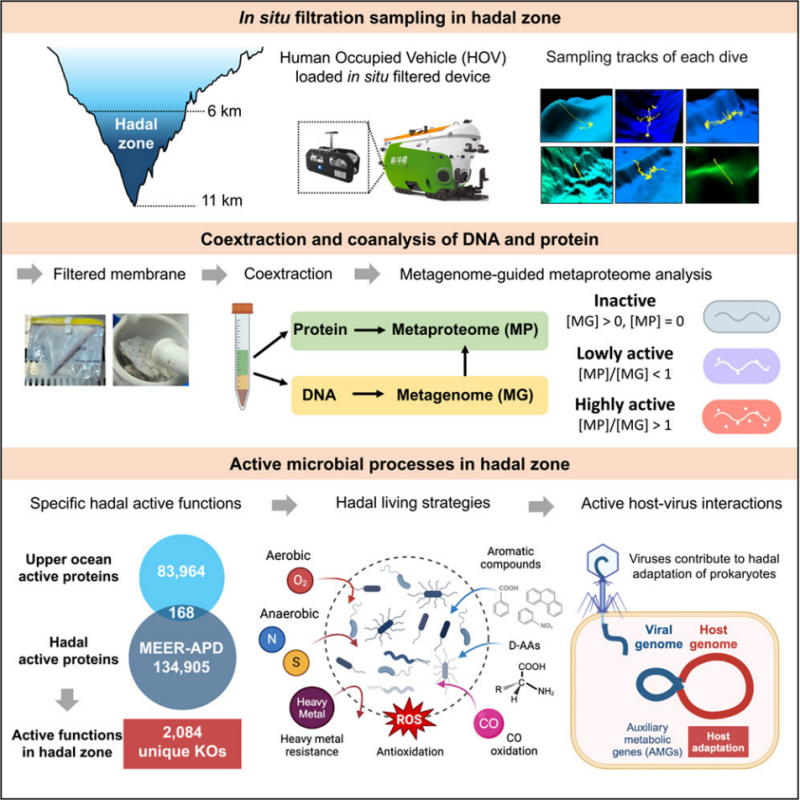 In situ filtration in the hadal zone feeds a paired DNA and protein coanalysis that classifies taxa by expression level, resolving the metabolic processes and virus-host interactions that are actively expressed there.
Where that activity concentrates depends on more than depth. In Mariana Trench sediments, work led by Shanghai Jiao Tong University and the Institute of Deep-Sea Science and Engineering (Chinese Academy of Sciences) with collaborators found that the Topographic Position Index (TPI), which scores a seafloor site as concave or convex, explained 16% of geochemical variance, against 9% for water depth. A concave location at a sediment depth of 2 to 4 centimeters supported 451 microbial lineages with detected protein expression, versus 92 at a nearby convex site. Reactive-transport modeling linked concave terrain to greater modeled organic-carbon supply and microbial carbon turnover, and microdiversity analysis pointed to predominantly upward dispersal, inferred computationally rather than directly tracked.
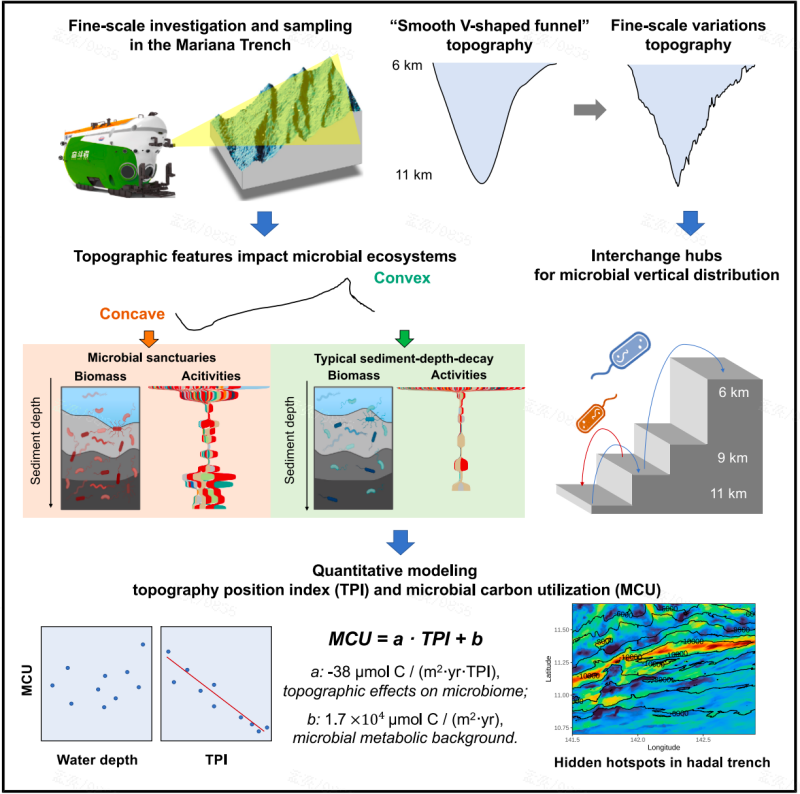 Fine-scale mapping and sampling in the Mariana Trench reveal concave microbial hotspots and link topographic position to modeled carbon utilization and inferred, predominantly upward dispersal.
With searchable gene and structure catalogs, a workflow for measuring protein expression in some of Earth’s most dilute ecosystems, and terrain-guided sampling strategies, researchers can now test how far these patterns extend beyond the Mariana Trench to other hadal systems, and what undiscovered biochemistry the deep ocean may still hold.
Research data including the deep-sea gene catalog and protein structure catalog have been incorporated into the Extremophile Multi-Omics DatabasE (ExMODE) and are now available on CNGBdb: https://db.genomics.cn/exmode/collections/dsgc
These research articles can be accessed at:
https://doi.org/10.1016/j.chom.2026.05.009
https://doi.org/10.1016/j.chom.2026.07.001
https://doi.org/10.1016/j.chom.2026.06.015
An accompanying opinion article about this project can be accessed here: