



On August 27, researchers from the State Key Laboratory of Genome and Multi-omics Technologies at BGI-Research, Zhejiang University, the Kunming Institute of Zoology of the Chinese Academy of Sciences, Marquette University, and collaborating institutions report in Science a comparative genomic study of geckos showing that the origins and evolution of sex chromosomes are not entirely random. The work suggests that paleoclimate and the gene content of ancestral chromosomes can help shape the when and how the system evolve.
 The study, titled “Genomic predisposition is associated with the direction of sex chromosome evolution,” was published in Science.
In vertebrates, sex can be determined in strikingly diverse ways. In some species, sex is determined by the environment, such as incubation temperature. In others, it is written into the genome through sex chromosomes. These genetic systems usually fall into two broad forms: XY systems, in which males carry two different sex chromosomes, and ZW systems, in which females do. Why one lineage takes the XY route while another takes the ZW route has remained a basic question in evolutionary biology.
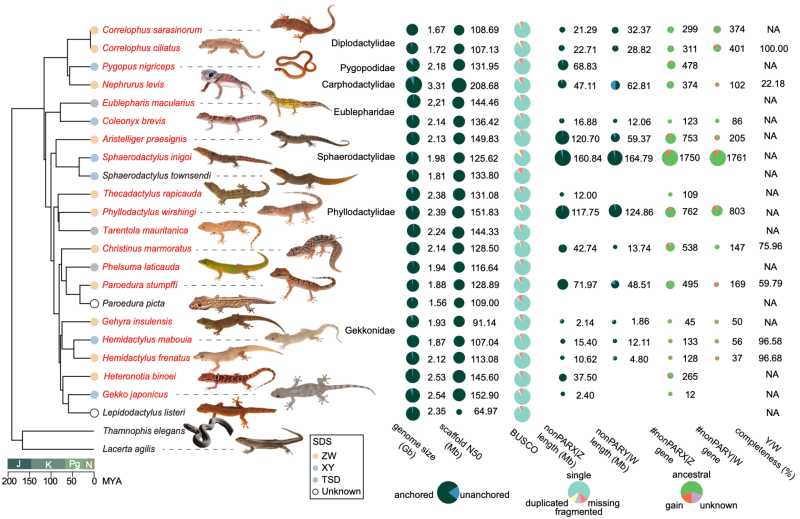 Gecko genome assemblies, phylogeny, and sex-linked sequence dataset.
Geckos offered a natural experiment of sex chromosome evolution. Across this group of lizards, there are species with temperature-dependent sex determination, XY systems, and ZW systems; these sex chromosomes are also at different stages of differentiation. To capture this diversity, the team generated high-quality chromosome-level genomes for 19 gecko species spanning all seven gecko families. Together, these species capture roughly 70 percent of currently known independent sex chromosome origins in geckos.
The first surprise was how many times gecko sex chromosomes have independently evolved. By reconstructing the ancestral karyotype of the most recent common ancestor of geckos, the researchers traced the ancestral chromosome that gave rise to the sex chromosomes seen in the modern species. They found that sex chromosome systems across the sampled geckos were derived from 17 different ancestral chromosomes. In other words, most gecko sex chromosomes do not descend from one single ancestral sex chromosome, but rather arose repeatedly and independently from different parts of the genome.
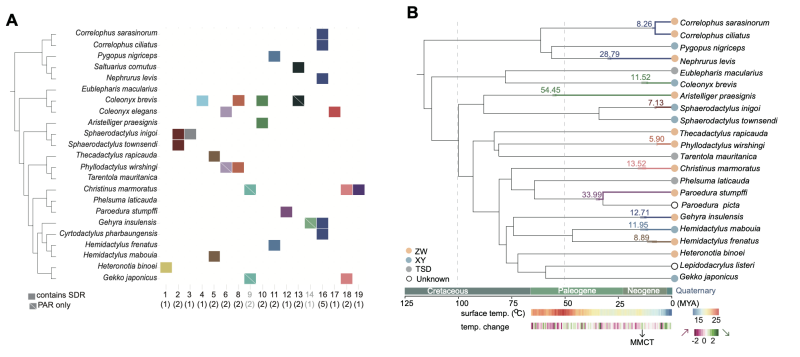 Gecko’s independent sex chromosome origins (Graphic A) and divergence times (Graphic B).
But independent did not mean total random. When the team estimated the sex chromosome age, many of the sex chromosomes clustered in time. Among 11 origins that could be dated, five fell between about 7 million and 12 million years ago. This narrow window happens to overlap with the Middle Miocene Climatic Transition, a period marked by global cooling, drying, and habitat fragmentation. The study cannot prove that climate change directly created new sex chromosomes, but it points to a plausible link: for species whose sex depends on temperature, a more unstable climate may have made environmental sex determination less reliable, favoring a shift toward genetic sex determination.
A second question then follows: if an ancestral autosome is recruited to become a sex chromosome, which way it will evolve, XY or ZW?
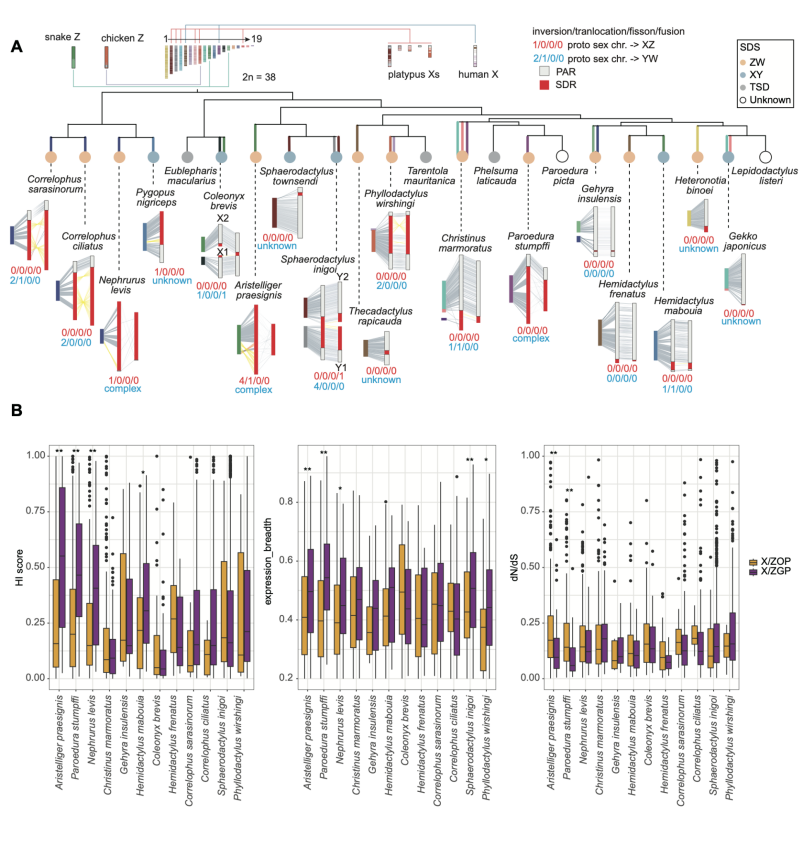 Graphic A: Repeated independent origins of gecko sex chromosomes.
Graphic B: Comparison of HI score, expression breadth, and dN/dS between X/Z genes with gametolog pairs (X/ZGP) and X/Z genes without gametolog pairs (X/ZOP).
Here the team found evidence that the answer may partly lie in the chromosome’s expression feature. Before becoming sex chromosomes, different genomic regions have exhibited different features: some regions are enriched in genes preferentially expressed in the testis, while others were depleted of such genes. The team found that, in geckos, those regions enriched for testis-preferentially expressed genes tended to evolve into ZW systems, whereas regions with fewer such genes tended to evolve into XY systems.
To test whether this pattern can be applied to broader phylogeny, the researchers extended the analysis to 39 vertebrate species. The same association appeared across other amniotes (e.g., therian, monotreme, and some reptiles and snake), but was weaker or absent in amphibians and fishes. One possible explanation is reproductive biology. In amniotes, internal fertilization and the large excess of male over female gametes may intensify selection on genes involved in male reproduction, making ancestral testis-biased gene content more influential in the future direction of sex chromosome evolution.
The researchers also examined what happens after a sex chromosome system is established. Over time, X and Y (or Z and W) gradually stop recombining and start to accumulate mutations lose genes, a process often described as degeneration. In 12 gecko species where sex-differentiated regions could be identified, seven showed clear “evolutionary strata” — stepwise layers of suppressed recombination - while five showed more gradual differentiation. Structural changes, especially inversions, were a common route to reducing recombination and occurred mainly on Y or W chromosomes.
As Y and W chromosomes degenerate, not all genes are equally likely to be lost. The genes that survive might be expected to have sex-specific roles, but the gecko data pointed elsewhere. Surviving Y/W genes were more often involved in basic cellular functions, suggesting that they are retained because their dosage is important. In older, more differentiated sex chromosome systems, retained genes tended to show higher dosage sensitivity, broader expression across tissues, and stronger evolutionary constraint. This supports the idea that gene survival is shaped less by sex-specific function than by the need to preserve core biological balance.
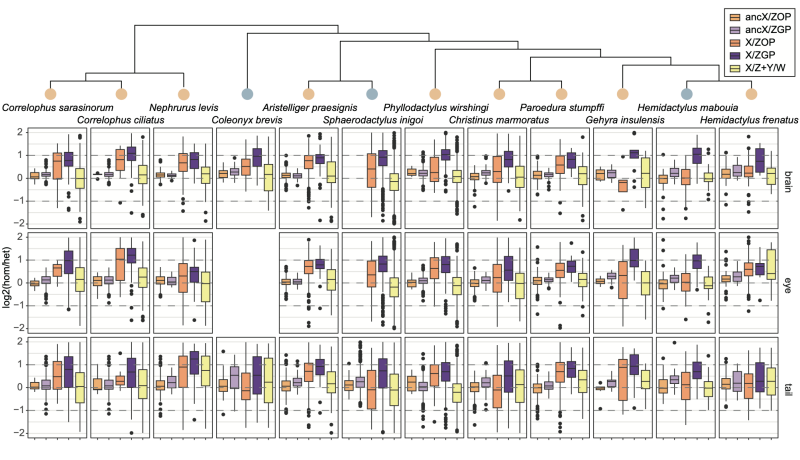 The pattern of dosage balance in geckos.
That balance is also visible at the level of gene expression. When genes are lost from the Y or W chromosome, the heterogametic sex (i.e., XY or ZW) is left with only one functional copy for many genes. Across gecko lineages, the team found repeated evolution of partial dosage balance between sexes. Rather than downregulating the expression in the homogametic sex (i.e., XX or ZZ), geckos generally upregulated X or Z chromosome genes in the heterogametic sex. Similar patterns have been reported in birds and snakes, suggesting that such upregulation may be a common evolutionary compensation strategy.
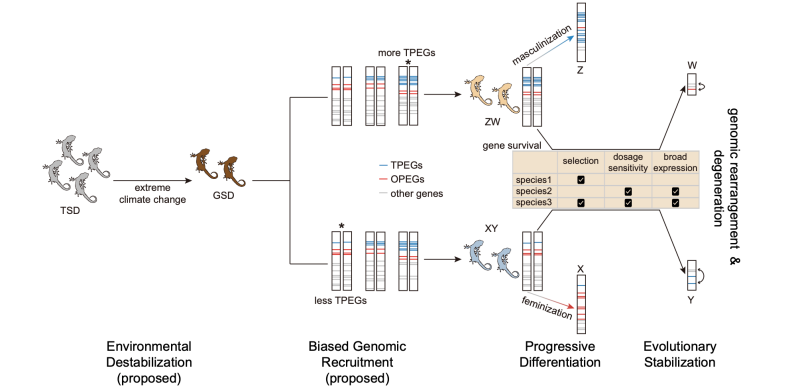 Model of sex chromosome evolution.
Together, the findings led the authors to propose a four-stage model of sex chromosome evolution. First, environmental instability may destabilize temperature-dependent sex determination. Second, genetic sex determination becomes established, with ancestral gene content biasing whether the system moves toward XY or ZW. Third, chromosomal rearrangements such as inversions suppress recombination and drive sex chromosome differentiation. Finally, Y/W degeneration and dosage compensation create long-term constraints that help stabilize the new system.
The work reframes sex chromosome evolution as neither fully predetermined nor purely accidental. Environmental pressure may open the door, but the genome itself helps decide which path is taken.
The gecko genome and transcriptome data have been deposited in GenBank under project accession PRJNA1288340 and in CNGBdb under accession CNP0005488. In-house scripts are available through the project’s GitHub repository at https://github.com/Dived-Jin/Gecko_Sexchromosome. This study can be accessed here: https://www.science.org/doi/10.1126/science.aec3449.