



As whole-genome sequencing becomes increasingly accessible, one of the biggest challenges in precision medicine is no longer generating genomic data, but identifying which genetic changes truly matter for disease. Traditional genome-wide association studies, or GWAS, have discovered many disease-linked loci, but they often require large cohorts and may struggle with rare diseases, low-frequency variants, complex haplotypes, and fine-scale localization of causal regions.
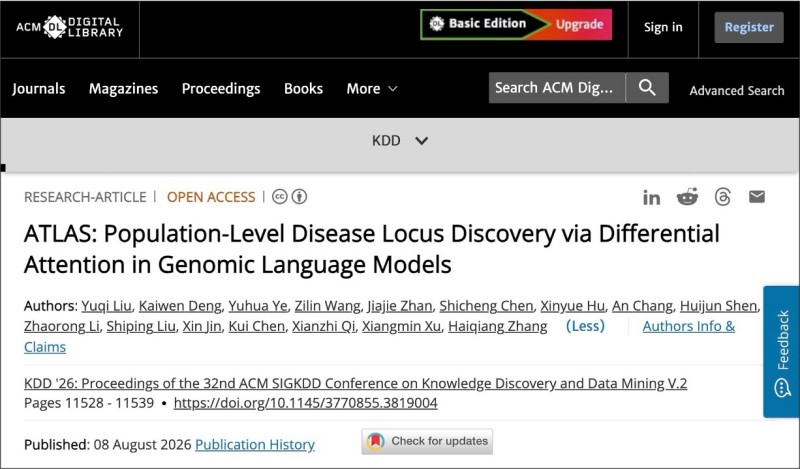 The study, titled “ATLAS: Population-Level Disease Locus Discovery via Differential Attention in Genomic Language Models,” has been accepted by ACM SIGKDD Conference on Knowledge Discovery and Data Mining (KDD).
To address these challenges, researchers from BGI-Research, Zhejiang Lab, Southern Medical University and collaborating institutions developed the Attention-based Locus Analysis System, or ATLAS, a disease locus discovery framework powered by genomic foundation models. The study, titled “ATLAS: Population-Level Disease Locus Discovery via Differential Attention in Genomic Language Models,” has been accepted by ACM SIGKDD Conference on Knowledge Discovery and Data Mining (KDD), one of the world’s leading conferences in data mining, knowledge discovery, data science, and artificial intelligence.
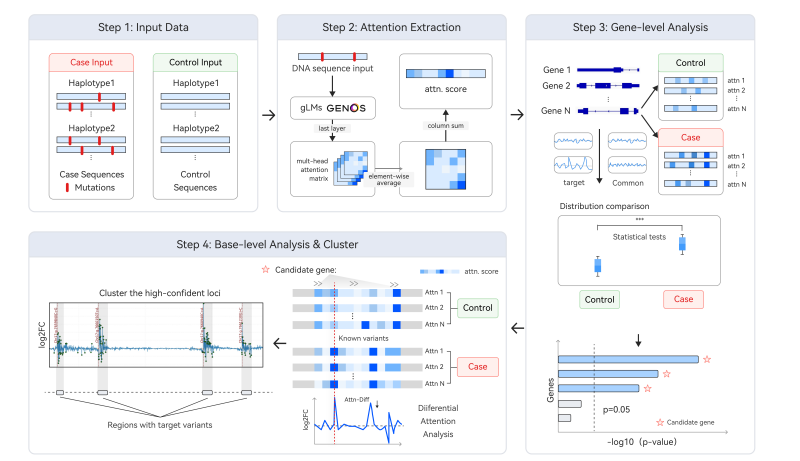 Overview of the ATLAS workflow.
The key idea behind ATLAS is simple but powerful: disease-associated genetic changes may alter how a genomic foundation model “reads” DNA. ATLAS uses Genos, a human-centric genomic foundation model, to process haplotype-resolved genome sequences from case and control groups. It then compares the model’s internal attention patterns between the two populations. If a gene or local genomic region consistently receives different attention in patients compared with controls, ATLAS flags it as a potential disease-associated signal.
This approach gives researchers a new way to mine disease information directly from genome sequences. Instead of relying only on variant-frequency statistics, ATLAS captures population-level changes in sequence representation learned by AI. This makes it especially useful in scenarios where traditional methods are limited, such as small patient cohorts, low-frequency variants, and diseases with complex genetic architectures.
The research team validated ATLAS using β-thalassemia, an inherited blood disorder with a well-established genetic basis. Using whole-genome sequencing data from research participants, ATLAS successfully identified HBB as the top disease-associated gene on chromosome 11. HBB is the major gene known to cause β-thalassemia, confirming that ATLAS can recover clinically meaningful disease signals from real-world genomic data.
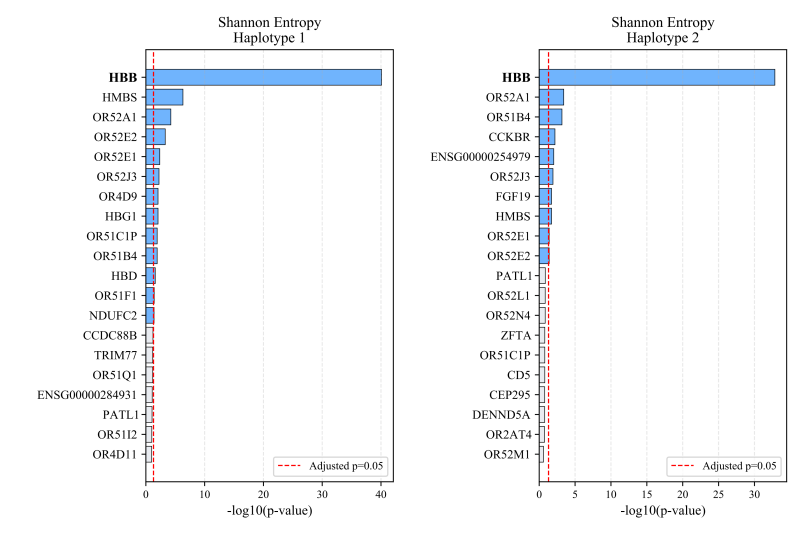 Top-20 genes ranked by differential attention entropy. The bar plots rank the top-20 protein-coding genes on chromosome 11, highlighting HBB as the most significant gene.
Beyond HBB, ATLAS also prioritized several biologically relevant genes, including HBD, HBG1, HMBS, and OR52A1. These genes are connected to hemoglobin biology, fetal hemoglobin regulation, thalassemia-related phenotypes, or known disease-gene resources. This suggests that ATLAS may help researchers uncover not only primary disease genes, but also additional modifier or regulatory genes that influence disease severity and clinical outcomes.
Importantly, ATLAS can go beyond gene-level discovery. In the β-thalassemia cohort, it localized attention-derived candidate regions at base-level resolution and recovered multiple clinically reported HBB variants. Compared with conventional GWAS under the study’s stringent threshold, ATLAS identified more disease-relevant HBB sites across both haplotypes. The candidate regions detected by ATLAS were also highly compact, with an average length of about 11.6 base pairs, which could greatly reduce the search space for downstream validation.
This has direct practical value. In clinical genetics and disease research, scientists often move from a broad candidate region to experimental validation, a process that can be time-consuming and expensive. By narrowing disease-associated signals to short candidate regions, ATLAS may help researchers prioritize targets more efficiently for functional studies, diagnostic interpretation, and future therapeutic exploration.
The framework also showed strong robustness in simulated datasets. ATLAS maintained clear localization signals when disease variants were present at low frequency (down to 10%) and remained effective in small-cohort settings (below 200 individuals per group), including simulations with as few as 10 individuals per group. These results indicate that ATLAS may be particularly valuable for rare-disease studies and early-stage genetic investigations, where large sample sizes are often unavailable.
Another important finding is that human-centric pretraining matters. The team compared multiple genomic language models and found that Genos models pretrained on diverse human genomic data performed better for human disease-locus discovery than larger models trained on broader non-human or multispecies genomic data. This highlights that in biomedical AI, bigger is not always better; the relevance and diversity of training data are critical.
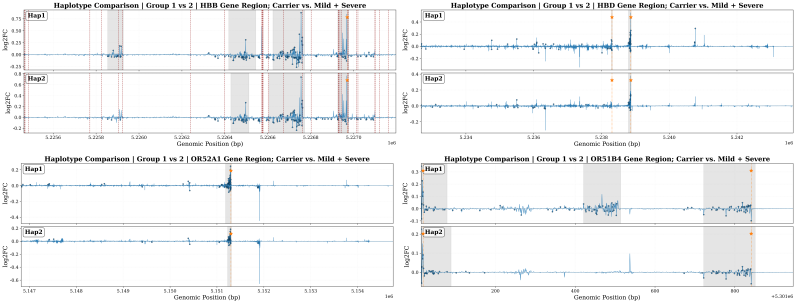 Comparison of derived clusters, known loci, and GWAS-inferred loci on both haplotypes. The four genes detected by both GWAS and ATLAS are shown. Gray regions indicate ATLAS-derived clusters, red lines indicate known loci, and orange stars indicate GWAS-inferred loci.
The significance of ATLAS lies in making genomic foundation models more actionable for precision medicine. Rather than serving only as general-purpose sequence predictors, these models can now contribute directly to disease gene prioritization and fine-scale locus discovery. ATLAS offers a complementary strategy to GWAS: GWAS identifies statistical associations, while ATLAS detects disease-related shifts in AI-learned genomic representations.
Looking ahead, ATLAS could support rare-disease research, small-sample clinical studies, low-frequency variant analysis, and the interpretation of complex genetic regions. By combining foundation models with population genomics, ATLAS provides a new route from raw genome sequences to biologically meaningful disease insights.
Ultimately, ATLAS demonstrates how genomic AI can move closer to real-world biomedical application: helping researchers find disease genes faster, narrow candidate loci more precisely, and better understand the genetic signals underlying human disease.
This study was approved by the relevant institutional review board, and all participants provided written informed consent in accordance with applicable research ethics regulations.
This study can be accessed here: https://dl.acm.org/doi/10.1145/3770855.3819004