



Recently, investigators at the State Key Laboratory of Genome and Multi-omics Technologies at BGI-Research, Pu’er University, and The First Affiliated Hospital of Kunming Medical University report in Cell Reports that reading gut bacterial genomes end to end with CycloneSEQ long reads sorts 1,150 strains into four ecological roles, and that scoring gut communities role by role reveals links to inflammatory bowel disease activity that whole-community measures can miss.
 The study “Complete genome-derived metabolic interactions reveal the impact of gut ecology on human health” was published in Cell Reports.
The gut houses trillions of microbes that behave less like a crowd than a working economy: some make nutrients, some live on what neighbors release, and many compete for the same meal. Their relationships have mostly been inferred from co-occurrence, but neighbors seen together are not necessarily trading; they may simply prefer the same conditions.
A more mechanistic approach converts each genome into a genome-scale metabolic model, a wiring diagram of what a microbe can build, import, and release. Most such models rest on draft assemblies pieced together from many fragments. If a bacterium’s metabolic capacity is a city map, a draft is that map cut up: main roads survive, but entrances, exits, and interchanges break first, and those are the transporter genes through which microbes exchange molecules.
Working from stool donated by 74 healthy volunteers, the team cultured bacteria and sequenced each isolate two ways, pairing short reads on DNBSEQ platforms with long reads from BGI’s CycloneSEQ system. Assembling both read sets closed 966 isolate genomes into complete circles and recovered 184 more from 127 cultures that held more than one organism, 1,150 in all across 199 species.
Against drafts of the same 966 strains, complete models typically carried reactions their draft counterparts lacked, weighted toward transport. Pooled across all the matched comparisons, those additions came to 4,756 distinct reactions. Fragmented draft sequences were also linked to spurious reactions, suggesting draft models are differently built, not merely smaller. On drafts, the same strains appeared more dependent on one another and less competitive.
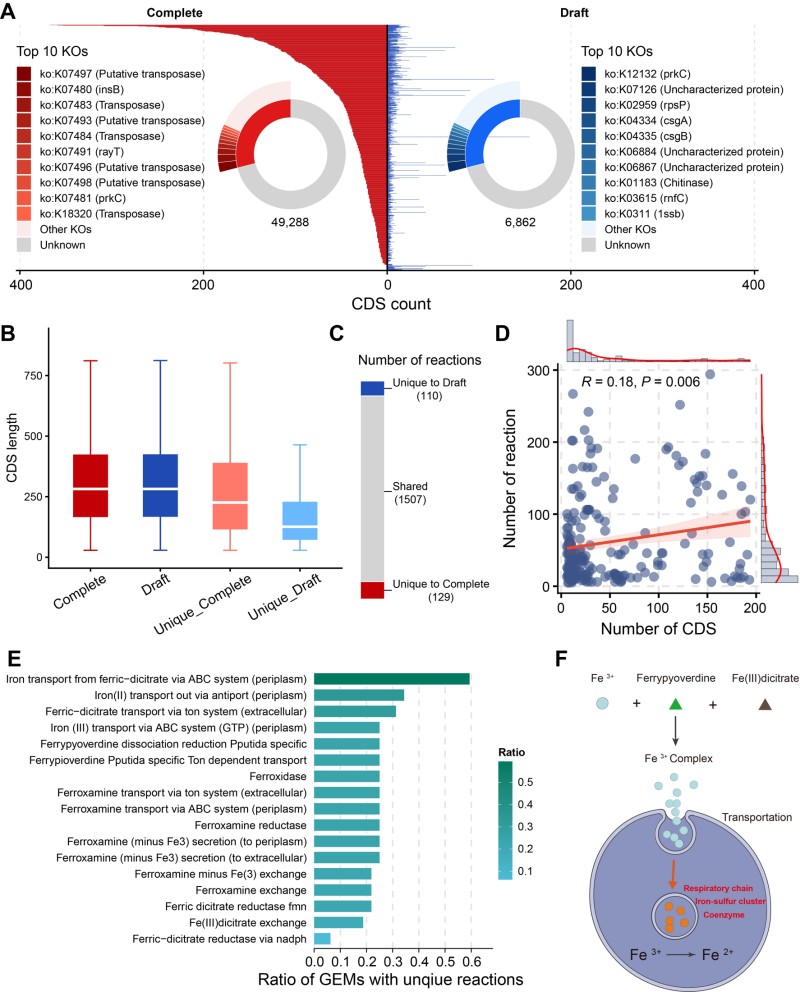 In matched comparisons, models built from complete genomes recover reactions their draft counterparts miss, most of them transport steps such as the machinery for taking up iron, the very functions through which microbes exchange molecules.
The researchers then scored every strain pair for competition, meaning overlapping nutritional needs, and complementarity, the capacity to supply what another cannot make. Both measures are directional, so it was the asymmetry between initiating and receiving, not taxonomy, that produced four groups. Resource predators compete hard for shared nutrients while initiating little exchange, a name about rivalry over food rather than preying on other cells; resource utilizers do the opposite, drawing on many partners while avoiding head-on competition. Active players initiate both competition and exchange, yet carry the smallest genomes. Resource contributors, despite the name, initiate little of either: they carry the largest genomes and the greatest transport capacity, come largely from the Enterobacteriaceae, and act as hubs others draw from and compete against.
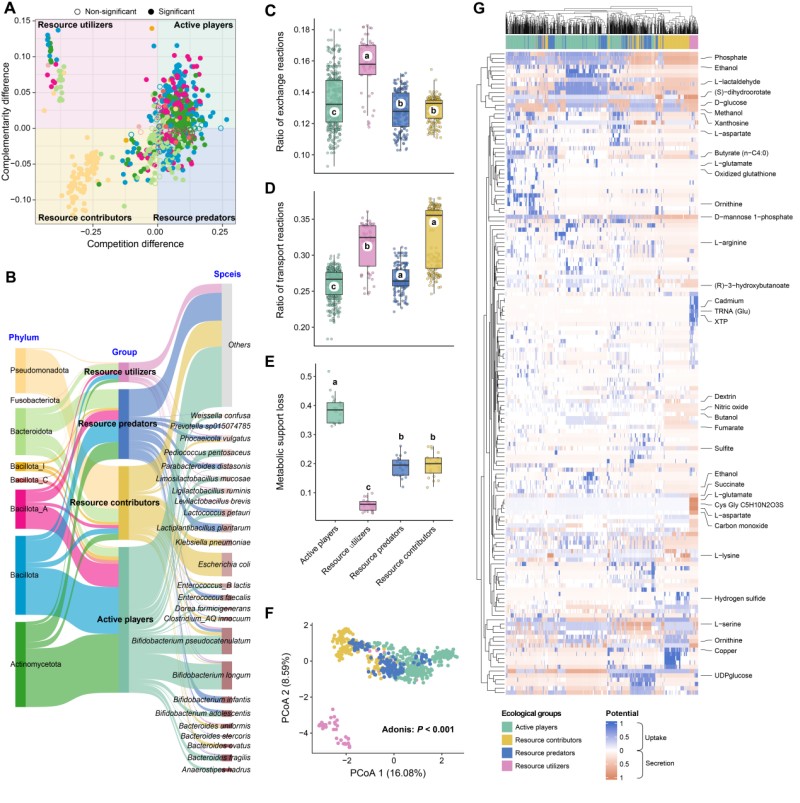 Two directional measures, competition and complementarity, place each strain in one of four quadrants that define the predicted ecological groups; in simulated communities, removing the active players reduces metabolic support for the rest more than removing any other group.
Applied to a longitudinal cohort of 130 people with and without inflammatory bowel disease, the framework showed which part of the community had shifted, not just that it had. Scored across the whole community, dysbiosis, a departure from a healthy reference profile, showed no significant relationship with fecal calprotectin, a routine stool marker of gut inflammation. Scored group by group on the same samples, dysbiosis among active players and resource predators correlated with calprotectin in Crohn’s disease, and group-specific scores tracked symptom indices in both Crohn’s disease and ulcerative colitis; most of these associations held after adjustment for age, sex, and medication.
The team also traced keystone taxa, network hubs and connectors predicted to matter out of proportion to their abundance. Adding metabolically defined keystones to abundance-derived ones improved cross-validated research classifiers separating cases from controls across ten disease cohorts, a proof of concept rather than a clinical test.
Resolution extended below the species level: strains of Bifidobacterium longum, a common probiotic, split into two metabolic subgroups, one predicted to release L-arabinose, a plant-fiber sugar, to the other. In simulated pairwise culture, strains unable to grow alone recovered alongside the complementary subgroup, suggesting the useful question for probiotics may be not only which species, but which strain and with which partners.
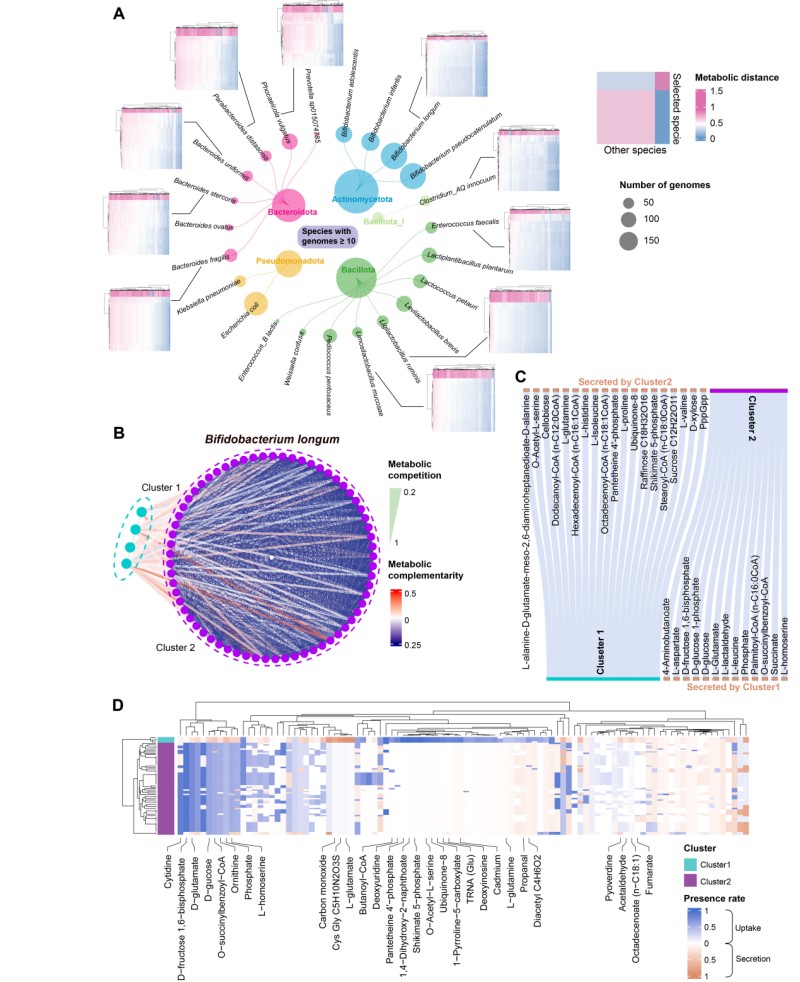 Bifidobacterium longum separates into two clusters with different predicted exchange profiles, Cluster 2 competing less and complementing more with Cluster 1 than with other Cluster 2 strains, so a species name is a coarse guide to strain behavior.
The work opens a network-level view of the microbiome, showing how metabolic connections can organize microbial communities and reveal changes that species lists alone may miss. Testing these predicted exchanges in culture and colonized animals, and extending complete-genome modeling to patient-derived and currently uncultured strains, could identify the connections most important for community resilience and guide future efforts to restore them.
This study has received ethical approval, and all participants provided informed consent. The genome collection is publicly available at CNGBdb under accession CNP0007680.
This research can be accessed at: https://doi.org/10.1016/j.celrep.2026.117913